Guest post by Joshua Oluwatumise, 2025-2026 Sustainability Leadership Fellow and Ph.D. Student in the Department of Systems Engineering
Three years ago, I stepped on a weight scale, and the number I saw pushed me to make a life-changing decision. Over these last three years, I have lost over 100 pounds. It wasn’t an easy or straightforward journey. There were days and weeks when I wanted to quit, mornings when working out felt like a punishment, days when dieting was painful, and plateaus where the number on the scale just didn’t move, making it feel like I was making zero progress. But I kept showing up. This personal journey gave me the perfect lens to understand my PhD research: why do people who buy electric vehicles (EVs) decide to stop using them? Research by Dua et al. (2024) found that approximately 34% of EV owners reduce or discontinue their EV use.
Stages of the journey

When I started my weight loss journey, I was motivated for all the right reasons. I wanted to be healthier, have more energy and strength, and be more confident in myself. The beginning of my weight loss journey felt electric. Every new healthy meal, every workout felt like the proof I needed to let me know I had made the right choice. EV buyers experience something similar. They drive off the lot powered by excitement about lower emissions, fuel savings, advanced technology, and that instant, smooth, and quiet acceleration of the electric motors. They are full of joy for all the right reasons and sure that they have made the right decision purchasing their EV. I call this the “initial enthusiasm stage,” and it’s real whether you’re talking about a new diet or a new drivetrain.
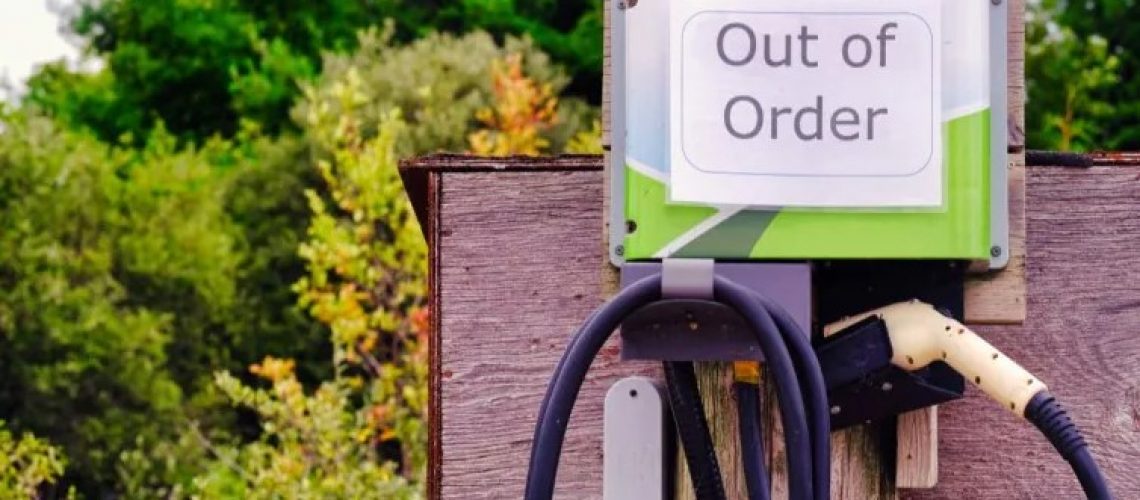
But then reality sets in. For me, it was the food cravings at midnight, the social pressure at cookouts, the lack of freedom to eat whatever I wanted, the strict workout routine I had to adhere to irrespective of how I felt, and the inconvenience of meal prepping on a Sunday evening when everyone else was relaxing. For EV owners, it’s the charging station that’s broken or limited when you’re running low on battery. It’s the range anxiety on a road trip through rural areas. It’s realizing that the public charging network you were promised hasn’t been delivered quite yet. Lifestyle mismatches set in, and differences in access to public charging infrastructure start to influence use behaviors (Hardman & Tal, 2021). In my research, I call this the “barrier encounter stage”. This is the phase where enthusiasm collides with the friction of the EV lifestyle reality.
Here’s where the stories diverge and where my research gets interesting. Whenever I felt like I hit a wall on my fitness journey, I had tools or other avenues to push through. Sometimes it was a supportive online community, sometimes adjustable strategies, and sometimes the freedom to change my approach. There was a lot of room for flexibility on the weight loss journey; however, when EV owners hit barriers, they often don’t have the same flexibility. They can’t will a broken charger into functioning, they can’t get tools to fix broken chargers, and they can’t shorten the time it takes to charge. And when those frustrations pile up, people start making decisions pertaining to the use of their EVs, sometimes without even realizing it.
That decision is what I study. I call it “EV Disengagement.”
Studying EV Disengagement
EV Disengagement isn’t just about someone selling their EV and buying a truck. It’s subtler than that. Some people keep their EV but start driving it less, opting for the gas car in the household instead. That’s what I call EV Under-utilization. Others eventually decide the whole experience wasn’t worth it and go back to internal combustion entirely, and that is called EV discontinuance Hardman & Tal (2021). Both behaviors undermine the environmental promise of EV adoption, and both are surprisingly understudied. If a third of EV buyers quietly go back to gas vehicles, the climate projections we’re banking on from transitioning to EVs start to fall apart.
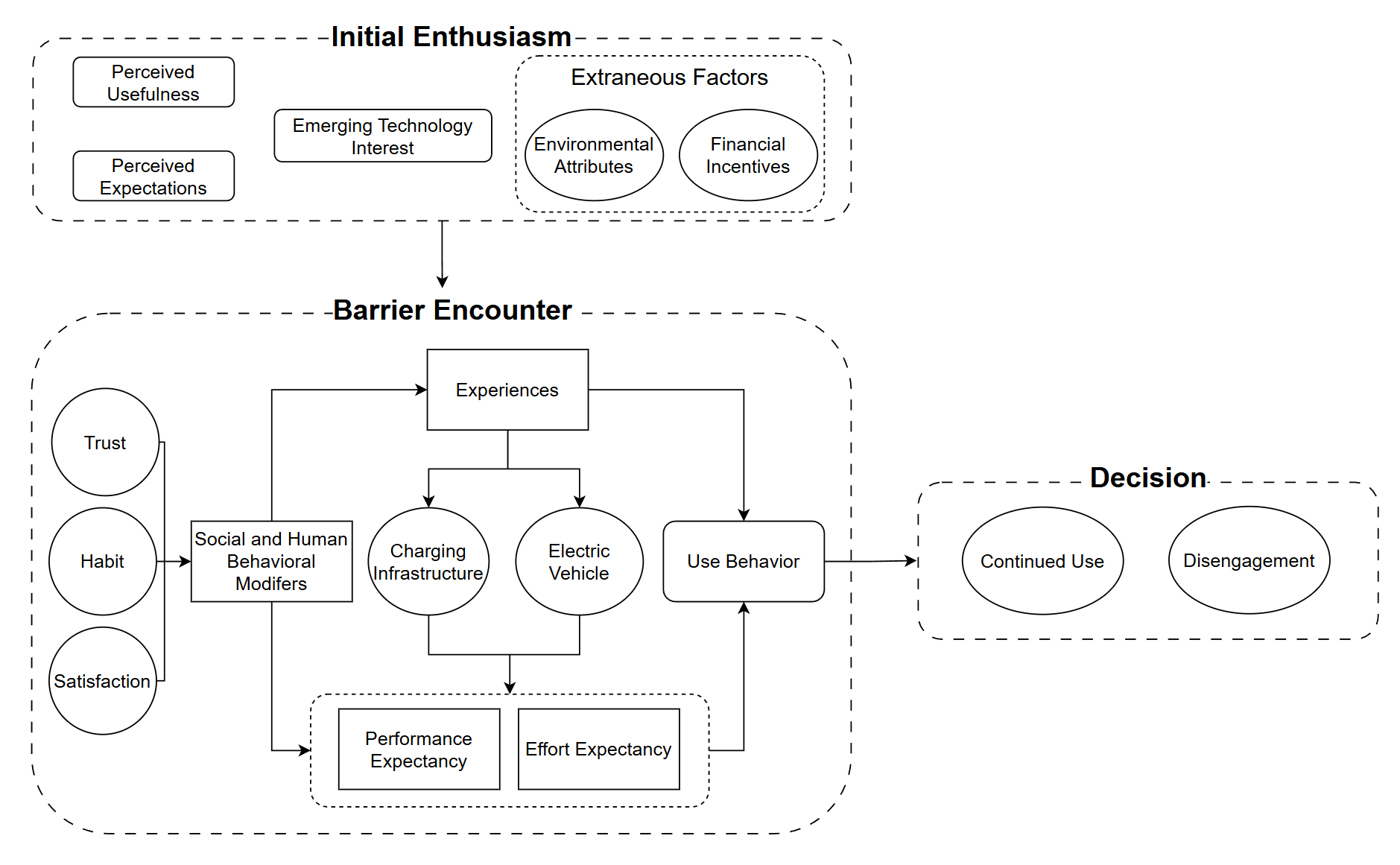
In my research, I’ve developed a conceptual framework to understand EV Disengagement behavior. Think of it as a map that traces the journey from buying an EV to potentially giving up on it. Examining this framework, we can see how the unmet expectations of the EV owners (in different dimensions) can lead to the decision to disengage.
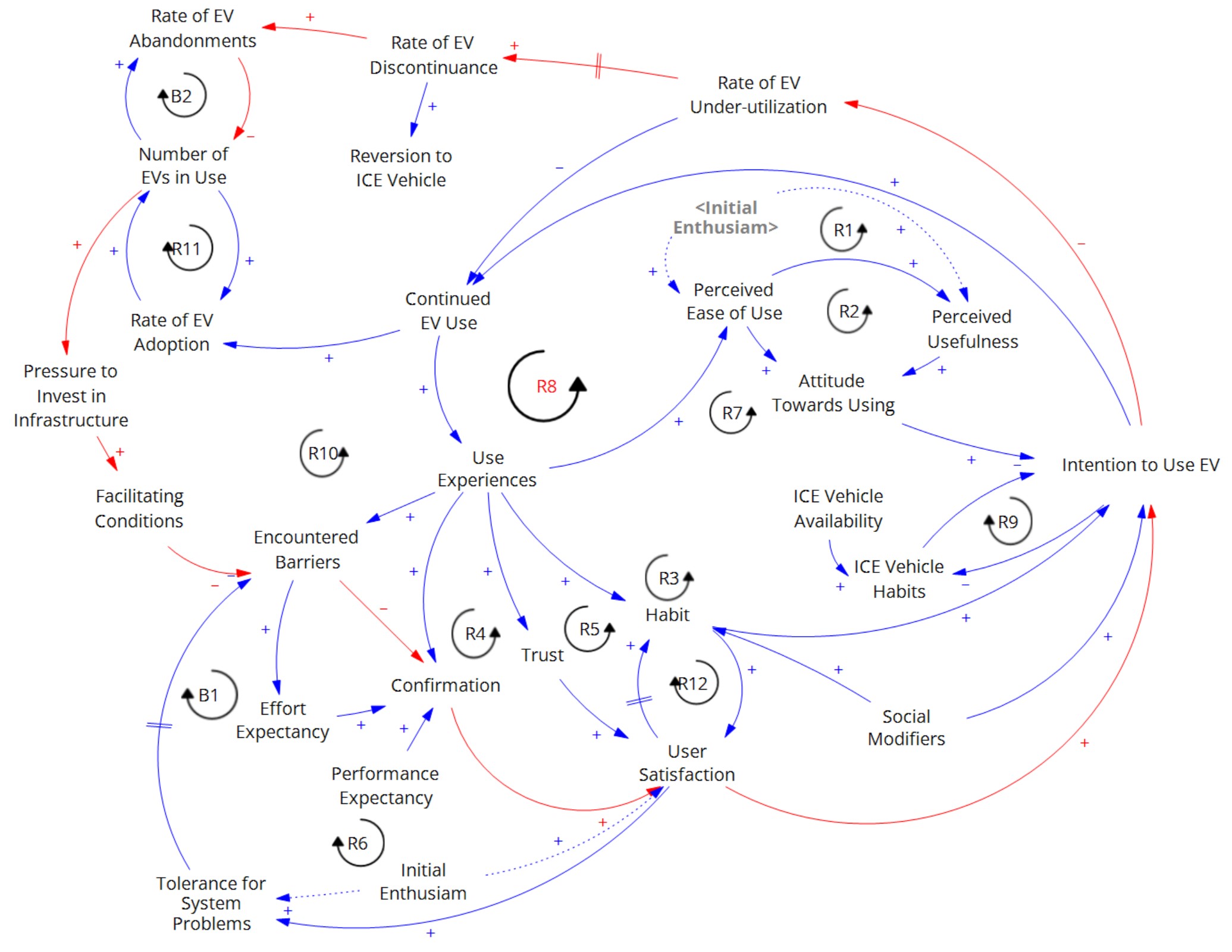
You know how you downloaded that productivity app, used it for about two weeks, and never opened it again? Researchers have developed frameworks to explain that behavior exactly see here, and I am applying those same ideas to EVs. Using those frameworks, I’ve built a model that identifies the factors pushing EV users toward disengagement. Spoiler: charging infrastructure reliability sits right at the center. If you follow the arrows in the figure below, you can see how unmet expectations through confirmation can snowball to giving up on EV use. This model illustrates the role of different factors, addressing questions such as Is using the EV worth the effort, Does the EV still feel useful, and ” Do I trust the EV to get me to where I need to go? These are some of the levers that determine if an EV owner remains or disengages.
Here in the US, this matters enormously. We’re a country with ambitious EV adoption goals, mountain highways that test range limits, and a charging network that’s still growing. If we want EVs to actually deliver on their climate promise, we need to understand why people disengage and what we can do about it to ensure this behavior no longer hinders the achievement of climate goals. It is also important to understand these behaviors to know how policy or other actors might help in reducing this behavior.
Losing 100 pounds taught me that the hardest part of any transformation isn’t the beginning. It’s the middle. It is the point when the novelty wears off, and you’re left with the repetitive daily grind. The same is true for EV ownership. My research aims to understand that middle part, map its terrain, and help ensure that the journey toward sustainable transportation doesn’t end with a U-turn back to the gas pump, because just like weight loss, the EV transition only works if people stick with it.
So, to you, the reader, what would it take for you to feel confident making the switch and staying with EVs?
References
Dua, R., Edwards, A., Anand, U., & Bansal, P. (2024). Are American electric vehicle owners quitting? Transportation Research Part D: Transport and Environment, 133, 104272. https://doi.org/10.1016/J.TRD.2024.104272
Hardman, S., & Tal, G. (2021). Understanding discontinuance among California’s electric vehicle owners. Nature Energy 2021 6:5, 6(5), 538–545. https://doi.org/10.1038/s41560-021-00814-9
Taherdoost, H. (2018). A review of technology acceptance and adoption models and theories. Procedia Manufacturing, 11th International Conference Interdisciplinarity in Engineering, INTER-ENG 2017, 5-6 October 2017, Tirgu Mures, Romania, 22, 960–967. https://doi.org/10.1016/j.promfg.2018.03.137