Guest post by Erin (Lexi) Sherman, 2025-2026 Sustainability Leadership Fellow and Ph.D. Candidate in the Department of Atmospheric Science
Last year, my New Year’s resolution was to read more. I used to be an avid reader, but being in an academically challenging graduate program has proven to be an efficient way to sap my energy and time. I don’t regret pursuing higher education at all, but I still miss being the person who could finish 500-page books in a day and stay up until 4 a.m. reading chapter after chapter.
Now, as a PhD candidate in Atmospheric Science, many of my nights are filled with reading paper after paper and finishing research tasks that take me three times the amount of time I expect them to.
Anyway, last year I read 27 books. Rookie numbers compared to my old self, but it was a lot more than I’ve been reading in the past few years, so I’m proud. I’ve never been a super picky reader, consuming all genres from classics to sci-fi, romantasy to horror. Still, recently I’ve noticed that almost every book I pick up falls under the general umbrella of speculative fiction. Speculative fiction is basically a genre that asks “what if”. It can have elements of magic, science, alternative history, horror, or dystopia/utopia. The only real qualifier is that something must be a bit “off” from reality. World-building, creativity, and imagination are requirements for successful books in this genre. Some popular books that can fall under speculative fiction are Parable of the Sower by Octavia Butler, I Who Have Never Known Men by Jacqueline Harpman, and Tender is the Flesh by Agustina Bazterrica.
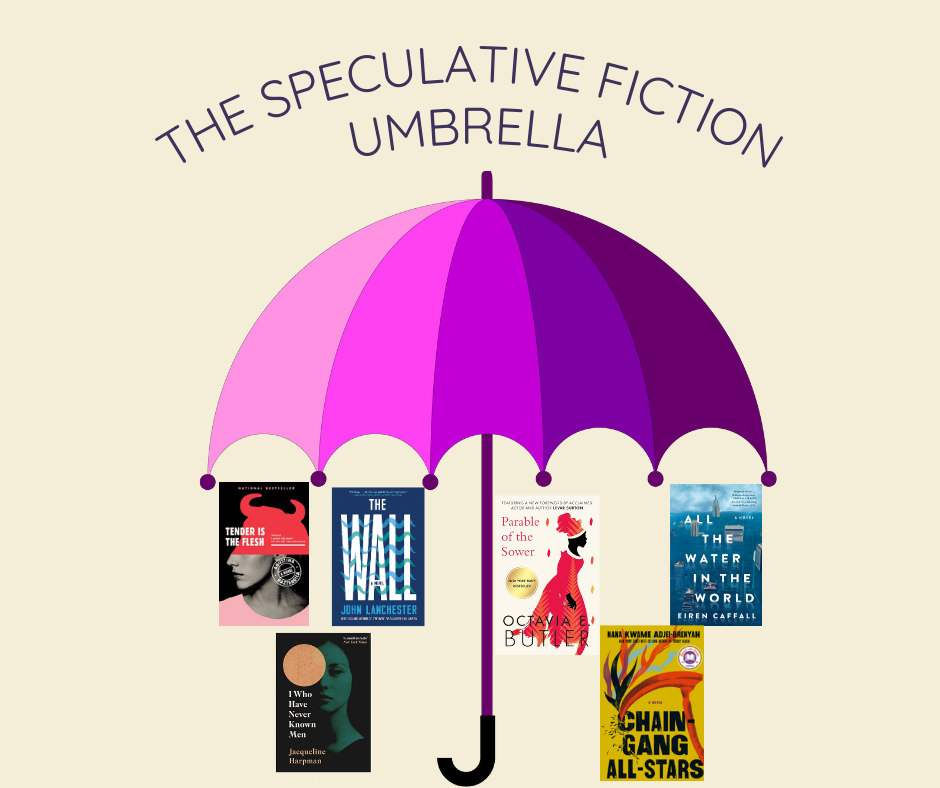
What I really enjoy about speculative fiction is the opportunity to analyze our real world through these extreme and sometimes absurd fictional scenarios. For example, in Tender is the Flesh, humans live in a world where animal meat becomes inedible, and all animals are considered a threat. In response, some humans are farmed for consumption, and all animals are nearly extinct. It’s an extremely disturbing premise and can be gory with descriptions reminiscent of Upton Sinclair’s The Jungle, but it offers us the chance to ponder surface-level themes like veganism, animal rights, and ethical consumptionTender is the Flesh also introduces broader ideas like how much we are willing to accept the mistreatment of others to maintain our own comfort, whether there is ever a point where a person can be stripped of their humanity and personhood, and what it means to be human.
My favorite subgenre under this umbrella is dystopian/apocalyptic fiction with storylines related to climate disasters. Coincidentally, this matches very well with my doctoral research. I only noticed this similarity recently, and it’s a bit of a chicken-and-egg question: Did my desire to understand how weather events might change in a future climate spark my love of apocalyptic fiction, or was it the other way around? In any case, this feels like a very telling personality reveal.
My whole job is to basically ask what if, and think of scenarios that are a little outside of our current reality, to hopefully learn more about our atmosphere and the complicated relationship we have with it. What if humans don’t curb their greenhouse gas emissions? What if the Earth warmed beyond a certain threshold? What if the winter precipitation in Colorado transitioned from snow-dominant to rain-dominant? What if extreme precipitation events become more likely in the future? It’s probably pretty evident that I could come up with a million other questions just like this, especially if I were to get specific with the details.
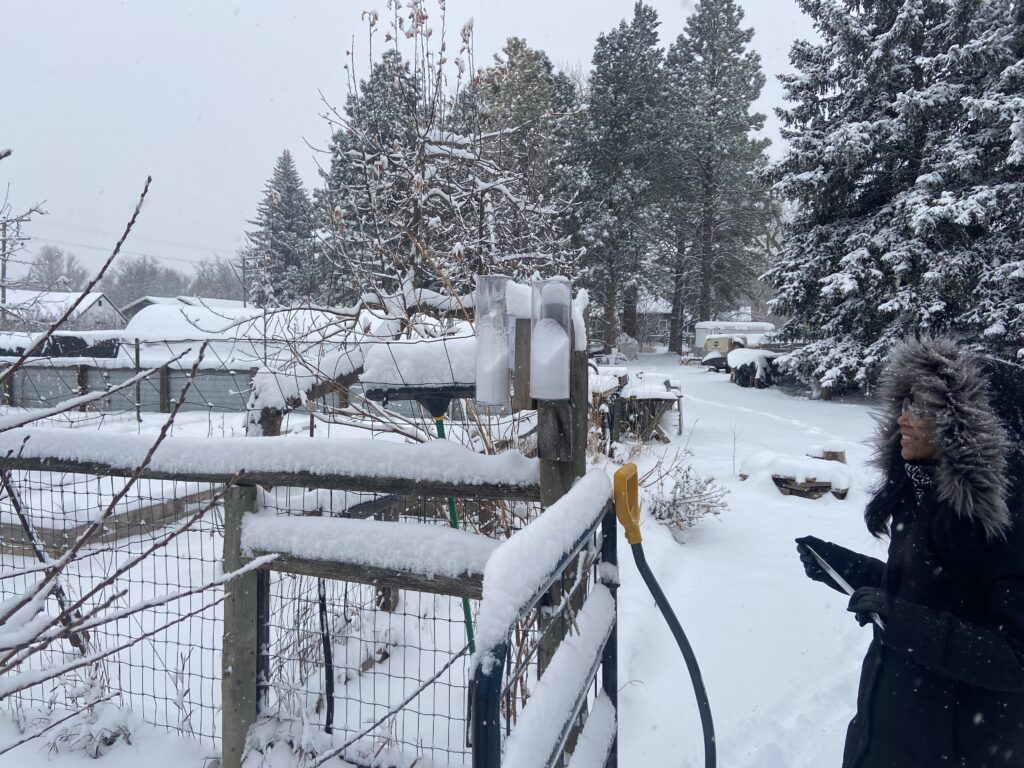
Right now, I am working to understand how anticipated environmental changes in response to a warming climate may affect precipitation in Colorado and Wyoming in the near future. It’s an interdisciplinary project, and I work with a great team to examine the sustainability challenges these two states face, the economic burden of extreme precipitation events, and policy on water rights. These states live in a fragile balance when it comes to water, so any change to the water budget can have massive cascading effects, both socially and economically. I have the fun task of visualizing what that future might be for us. I use weather and climate models (basically huge, complex calculators) and machine learning to try to predict the future of precipitation events. Maybe instead of Atmospheric Science PhD Candidate, my job title should be Aspiring Weather-Climate Psychic.
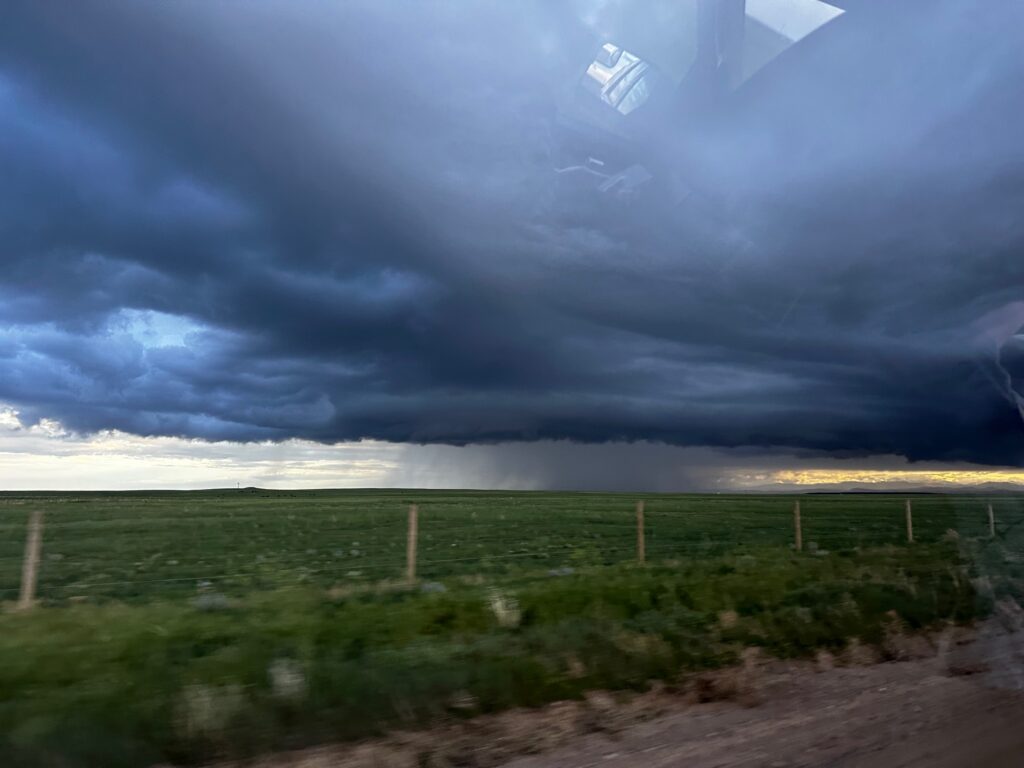
At the end of the day, I don’t see myself as all that different from the authors of the books I love so much. Of course, my work isn’t fiction or especially speculative; I use the best tools developed by world experts, along with my own scientific understanding of this topic, which I’ve developed through higher study over nearly a decade. However, on the surface level, I can relate to trying to understand something that is just outside our current realm of being. Most work done at this level is similar in a way, bringing yourself to the brink of human knowledge and then asking a question to press just beyond that. Additionally, I think these authors and I spend quite a bit of our time looking toward an uncertain future and pondering how it might differ from our present and what that might mean for ourselves, our communities, or even strangers on the other side of the world. The possibility of my work being used to bring about impactful change, inform policy, or help mitigate future problems before they even become issues is what drives me to continue down this path, even if it means I don’t reach my reading goal for this year.
I’ll continue attempting to answer my “what if” questions with the optimistic hope that we can combat the most detrimental impacts of climate change by working together as a global community. The biggest challenge is the human factor. What we all choose to do today has the biggest impact on what our future will be.
I just hope we don’t end up as a cannibalistic society with no pets.