
Guest post by Nicholas Parker, 2025-2026 Sustainability Leadership Fellow and PhD Candidate in the Department of Ecosystem Science and Sustainability, Graduate Degree Program in Ecology, and Natural Resource Ecology Laboratory (NREL)
Colorado’s mountain tops are a desolate place. If you were to venture there in early spring, the tundra appears as an empty expanse of glistening snowfields, brilliantly white under a clear blue sky. The only sound you hear comes from the never-ending wind, one moment bellowing its icy breath across the frozen landscape and the next whispering a cool breeze across the emptiness. Suddenly, a strange guttural scream pierces through the solitude. You catch a movement out of the corner of your eye. When you turn to look, all you see are rocks and snow. What was it? Bigfoot? A ghost? Perhaps. More likely it was a white-tailed ptarmigan, Colorado’s mysterious alpine resident, performing its spring mating ritual.
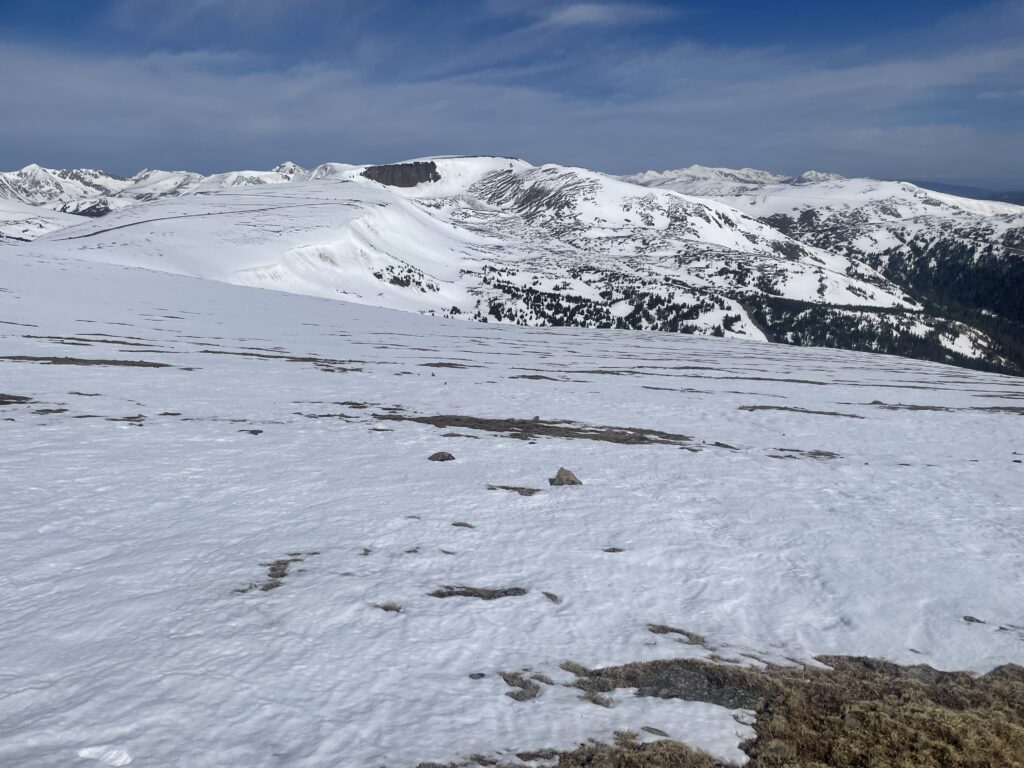
While most people are familiar with the legends of bigfoot, many have not heard of the white-tailed ptarmigan, Colorado’s own “ghost of the alpine.”1 A chubby, round bird shaped like a small football may not sound very ghost-like, but the white-tailed ptarmigan earns the name as a secretive dweller in some of Colorado’s most remote and harsh environments. Only found in areas above treeline (>11,000 ft), it is little wonder that some people have never heard of them, and even fewer have never encountered one. And with a changing climate these elusive creatures may be even harder to find.
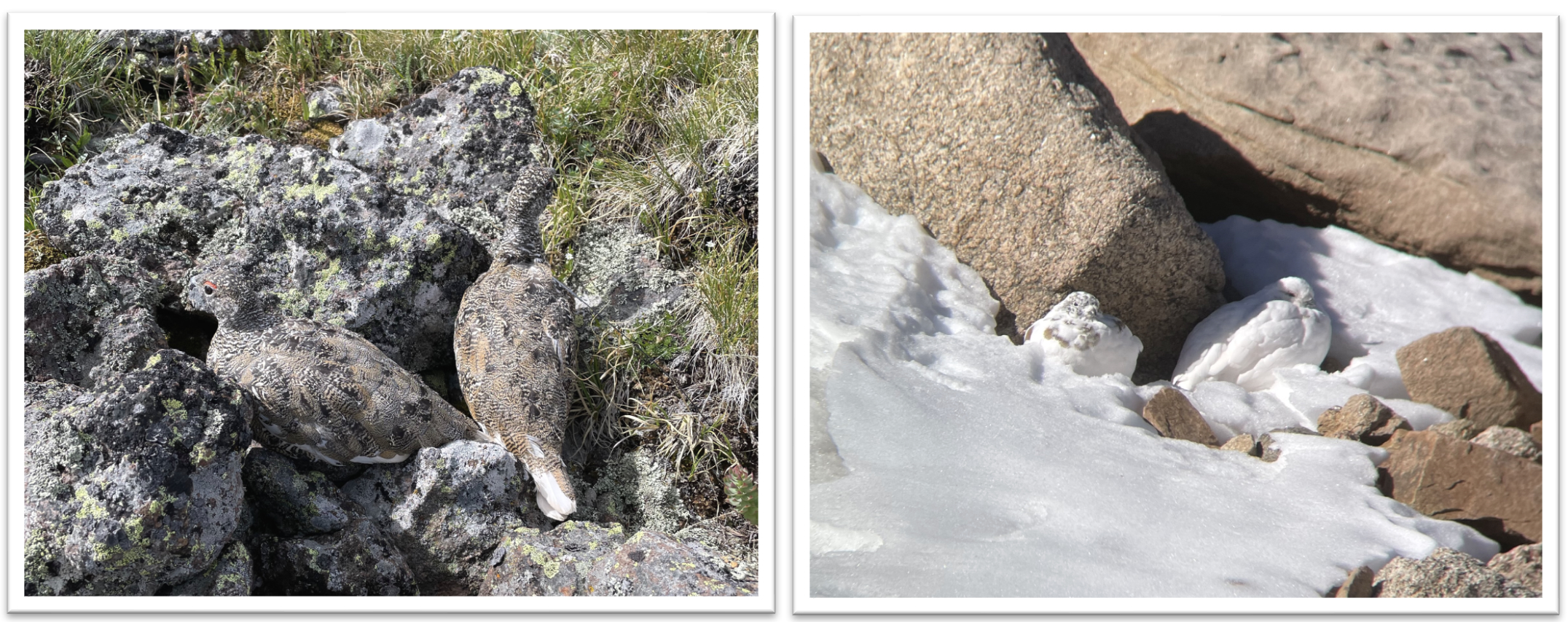
When sitting completely still, ptarmigan fade into their surroundings, making them nearly impossible to spot. During the winter their feathers are pure white, invisible against the snow. In the summer they turn into a mottled mix of brown, gray, black and gold, allowing them to disappear into the rocks and boulders which they so closely resemble.
One of the few times of year ptarmigan may try to make themselves seen is in the spring. Around this time, males compete for mates and become aggressive and territorial. They engage in fights with other males and broadcast their strange, high-pitched and chattering calls to scare off competitors (and superstitious hikers).
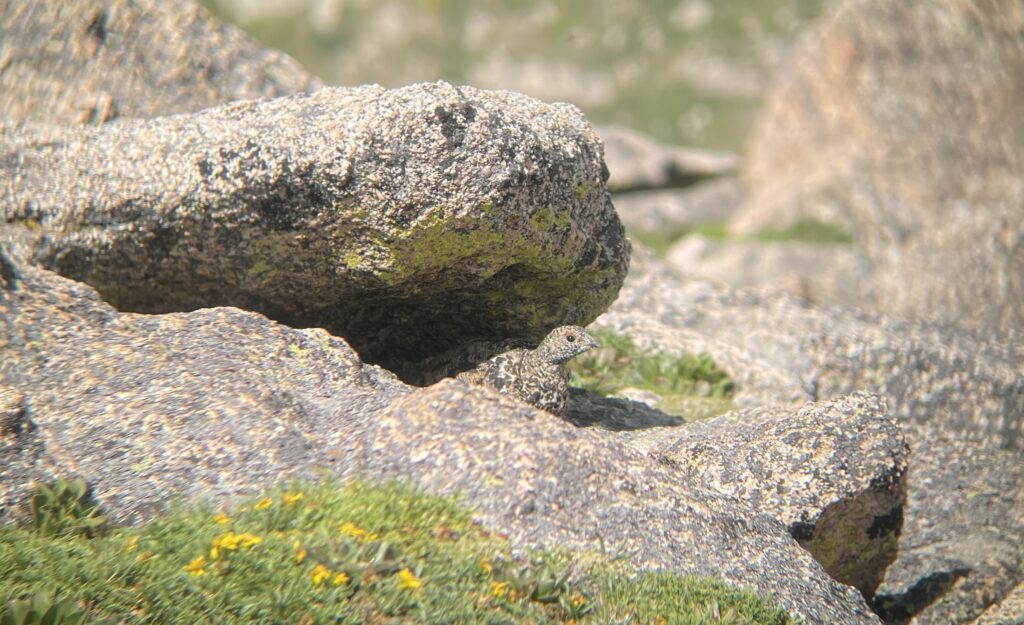
Unlike humans, white-tailed ptarmigan are most comfortable in the cold. To survive long, freezing winters in the alpine, white-tailed ptarmigan have dense feathers for insulation, even on their feet, and they dig themselves little caves in the snow to stay warm. In the summer they move to higher elevations, which are cooler and often have lingering snow. On a balmy, hot day for the alpine (>65 °F) you are likely to find ptarmigan seeking shade underneath a boulder, panting like a dog after a long run, or bathing in dusty, lingering snow patches; all in an attempt to cool down. Ptarmigan already occupy the highest areas in Colorado, and as temperatures warm in the alpine, there may be nowhere else for them to go.
Colorado is most well known for its mountains, but the alpine areas at the top of these mountains makes up only a small part of the state (about 3%). For the ptarmigan, that means areas where they can live are already quite limited. As the climate warms, trees and other species are predicted to move upward in elevation, transforming open alpine habitat into areas unsuitable for ptarmigan. Will the white-tailed ptarmigan be able to survive changing climates and habitats, or will it become a true ghost of the alpine, unable to survive in a new world?
Researchers at Colorado State University (CSU) are seeking answers from six decades of ptarmigan research in Colorado. Clait Braun, a CSU graduate student, began some of the first intensive studies on the white-tailed ptarmigan in Colorado in 1966. He studied two populations along the Front Range: one at Mt. Blue Sky just outside of Denver, and the other along Trail Ridge Road in Rocky Mountain National Park. Thanks to efforts from CSU, Colorado Parks and Wildlife, and the U.S. Geological Survey, monitoring of these populations has continued nearly uninterrupted until today.
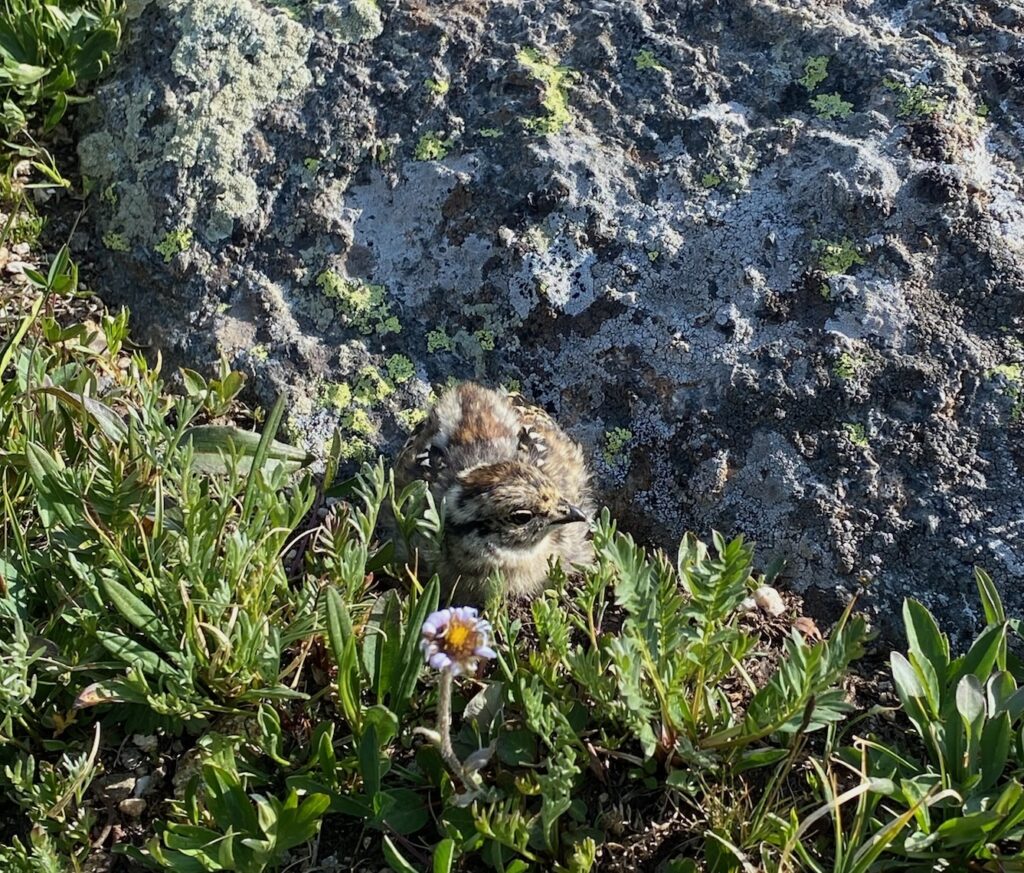
We now know that ptarmigan are nesting earlier in the year, thanks in part to warming temperatures and early melting spring snow.2 Typically, when nests hatch in mid-summer, there is an abundance of green plants, flowers, and insects for the small chicks to eat. However, with ptarmigan nesting earlier, the chicks hatch before the alpine has a chance to fully green up, reducing food for chicks and lowering their chances of survival.3 This appears to be the case at Trail Ridge Road, where the number the number of chicks and overall number of ptarmigan has declined since monitoring began in the 1960s. By looking backwards over long-term historical data we are able to gain new insights into what impacts future warming might have.
Sixty years after the study began, graduate students at CSU continue the long tradition of ptarmigan research using new tools. For my research, I equip ptarmigan with tiny backpacks which collect high-resolution GPS locations year-round. This gives us an unprecedented look into understudied aspects of the ptarmigan life-cycle, such as how ptarmigan move between remote mountain ranges.
Typically ptarmigan travel through alpine habitat, walking or flying from one mountain top to the next, but it has been unclear how they reach isolated alpine areas like Pike’s Peak or the Sangre de Cristo range. New data from GPS transmitters shows that ptarmigan travel as expected for the most part, staying in alpine habitat. However, we have now recorded ptarmigan using previously undocumented places, like clear cuts, areas near reservoirs, and meadows below treeline, using these as pit stops to connect distant alpine habitat. Understanding how ptarmigan move through landscapes is essential to understanding how climate change might impact the ability of ptarmigan to move between areas of habitat. As the alpine shrinks and the distance between habitat grows, some populations may be left isolated and at risk for local extinction.
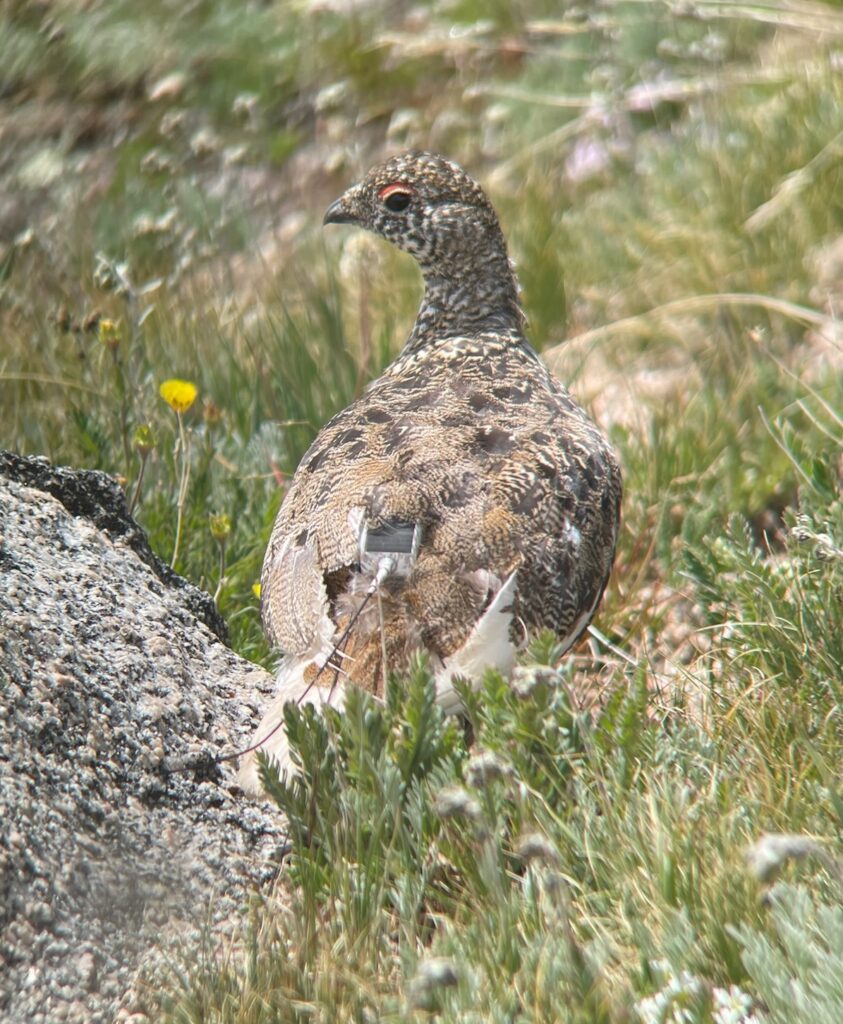
Over the past 60 years we have learned a lot about ptarmigan, and their remarkable ability to persist in an unforgiving and desolate place. The next 60 years will bring unprecedented change and new challenges. By combining research from past and present, we can focus conservation efforts on protecting and connecting critical habitat, to give the white-tailed ptarmigan the best chance at survival in the future. With this work, we hope to ensure that our “ghosts of the alpine” don’t become just a myth for future generations.
References:
- Gellhorn, J. 2007. White-tailed Ptarmigan: ghosts of the alpine tundra. Johnson Books. Boulder, Colorado, USA.
- Wann, G.T., Aldridge, C.L. and Braun, C.E., 2016. Effects of seasonal weather on breeding phenology and reproductive success of alpine ptarmigan in Colorado. PLoS One 11:e0158913.
- Wann, G.T., Aldridge, C.L., Seglund, A.E., Oyler‐McCance, S.J., Kondratieff, B.C. and Braun, C.E., 2019. Mismatches between breeding phenology and resource abundance of resident alpine ptarmigan negatively affect chick survival. Ecology and Evolution 9:7200-7212.