Guest Post by Erin Jackson, 2024-2025 Sustainability Leadership Fellow, and Ph.D. Student in the Department of Soil and Crop Sciences, Graduate Degree Program in Ecology, and 2022 InTERFEWS Fellow at Colorado State University
Agricultural systems are under increasing demand to produce food while contending with rapidly degrading soils and increasingly variable and extreme climatic disturbances. In addition to contributing to a dramatic loss of ecosystem services and biodiversity, a recent FAO report, The State of Food and Agriculture 2023, reveals how the industrial agriculture system perpetuates social injustices and health issues through exploitative labor practices and reliance on toxic chemicals that disproportionately burden people of low socioeconomic status1. Agriculture is both a contributor to and victim of the climate crisis; globally, the sector is responsible for nearly 30% of all greenhouse gas emissions. However, these challenges also present a huge opportunity: agriculture can support ecological health, economic prosperity, climate change mitigation, social justice and community well-being if done differently. And research programs play an important role in supporting this transition.
The principles of agroecology provide an alternative to the current food system that are based on social, ecological and political principles to create a more socially just and ecologically resilient food system2. The history of agroecology, as recognized by Western science, can be traced back to at least the 1930’s3 with roots in Indigenous, traditional and peasant knowledge and practices. Agroecology first emerged as a movement in Latin America in response to the Green Revolution by smallholder farmers resisting industrial agriculture methods to protect smallholder and indigenous farming systems4 and gained traction globally as the international peasant’s movement for food sovereignty, La Via Campesina5,6. Separately, throughout the 20th century, the term agroecology was defined by biophysical scientists in ecology and agronomy finding intersections between the two disciplines7. Agroecology is now widely recognized as a transdisciplinary co-production of movement, science and practice integrating social and natural sciences and community-led movements4,6–8.
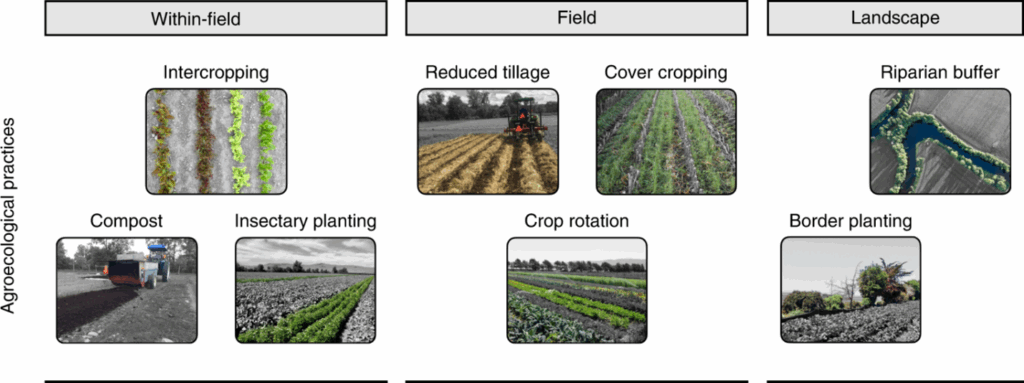
Agroecology embraces the idea that there are relationships among organisms and that harnessing these relationships can have positive impacts on ecological and socio-political outcomes. Agroecological farming practices can increase biological diversity, climate resilience, and support ecosystem services such as soil nutrient cycling, pollination, pest control and yield using natural processes in place of chemical inputs9,10. Some of the most common practices include: agroforestry, compost or manure addition, intercropping, pollinator and border plantings, reduced tillage, diverse crop rotations, cover cropping, perennialization and riparian buffers10,11 (Figure 1). Often used as a suite of practices rather than in isolation, these management strategies play an important role in the productivity and resiliency of agricultural systems. Practitioners of agroecology include farmers, extension professionals, NGO staff, government and academics who work with agriculture from the field to policy scale3.
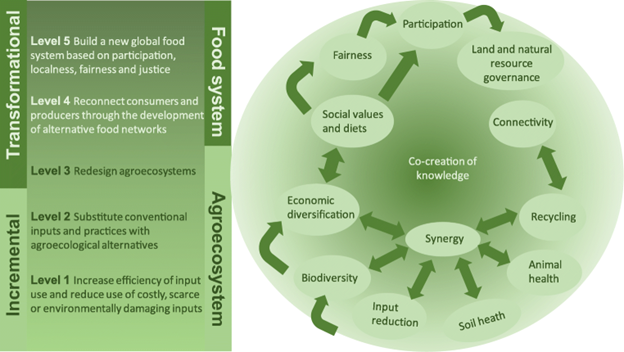
A critical component of agroecology is the understanding that food systems are intertwined with natural and human ecosystems. The 13 principles of agroecology (Figure 2) represent changes to the food system that can be incremental—such as improving soil health and reducing inputs—to transformational. Transformational changes promote equity and justice through responsible and inclusive governance and respecting multiple ways of knowing about the diversity of agroecosystems with which humans coexist12,13. Co-creation of knowledge is a central principle of agroecology that relies on participatory processes to include the perspectives of many actors14.
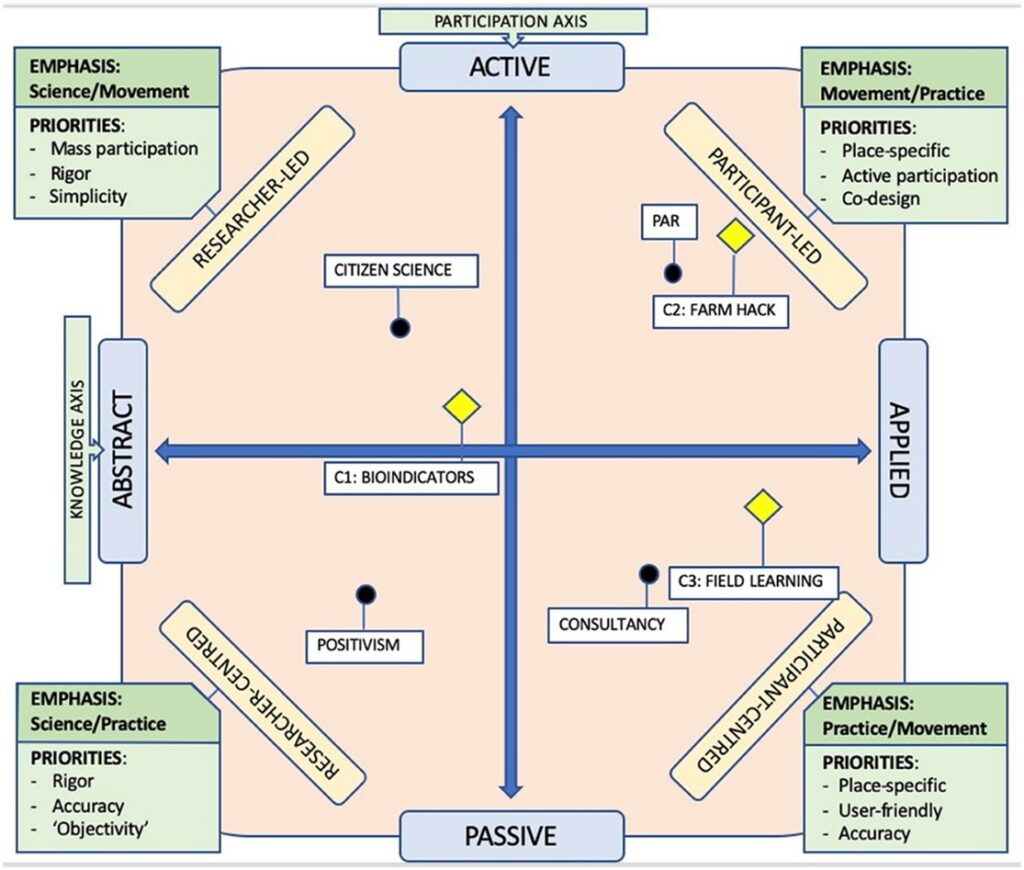
Research can play an important role in aligning our food and agricultural systems with agroecological principles. Agroecological research spans a continuum based on the level of participation and type of knowledge generated, as conceptualized in Maughan and Anderson (2023)14 (Figure 3). A passive level of participation from stakeholders and a focus on generating abstract knowledge may include biophysical studies aiming to optimize efficiency of agroecological practices. At a high level of participation with applied knowledge production are participatory, community-centered studies that involve farmers, land managers and communities in the co-development of research questions and methods. While the methods, goals and outcomes of agroecological research vary, in general, research following agroecological principles recognizes the importance of addressing challenges in food and agricultural systems through context-specific knowledge at the field, farm or community scale to account for the variability and complexity of agroecosystems and socioecological dynamics.
As a PhD candidate in agroecology, my research involves participatory methods that directly engage producers. The research questions and study design for my current project, for example, were developed in collaboration with producers and funded by a Western SARE Graduate Student Research Grant that emphasizes producer participation. This project examines the potential for and impacts to soil-water-nutrient dynamics in dryland vegetable production in the semi-arid Northern Great Plains. The study follows a “parent and baby trial” design15: two replicated, randomized “parent” experiments are established at university research sites and a subset of treatments are tested in farmer-led “baby” experiments on participating farms. In addition to biophysical data collection, I am conducting interviews with producers to assess motivations, perceptions, and socioeconomic impacts regarding dryland vegetable farming as a climate resilience strategy. This project also establishes a regional network of producers, food system stakeholders, and researchers engaging in dryland vegetable farming for technical support, knowledge sharing and co-learning.
The intentional co-creation of knowledge with producers and land managers, which requires active participation and applied research questions, can reduce the barriers to adoption of evidence-based agroecological practices because the outcomes will be rooted in true constraints and needs of those implementing them. Participatory research can be challenging to implement and is not realistic in every context, but it is an important methodology for translating science into practice, and vice versa. Applying the framework of agroecology to a research context is one effective approach for ensuring research is relevant and empowering to communities with outcomes that will be useful in creating climate resilient, equitable food systems.
References
- FAO. The State of Food and Agriculture 2023. http://www.fao.org/documents/card/en/c/cc7724en (2023) doi:10.4060/cc7724en.
- IPES-Food. From Uniformity to Diversity: A Paradigm Shift from Industrial Agriculture to Diversified Agroecological Systems. International Panel of Experts on Sustainable Food Systems. https://cgspace.cgiar.org/server/api/core/bitstreams/db2469e8-fba3-48d5-929d-fba71aa71457/content (2016).
- Montenegro de Wit, M. & Iles, A. Toward thick legitimacy: Creating a web of legitimacy for agroecology. Elem. Sci. Anthr. 4, 000115 (2016).
- Wezel, A. et al. Agroecology as a science, a movement and a practice. A review. Agron. Sustain. Dev. 29, 503–515 (2009).
- Desmarais, A. A. La Vía Campesina: Globalization and the Power of Peasants. (Fernwood Pub. ; Pluto Press, Halifax : London ; Ann Arbor, MI, 2007).
- Gliessman, S. Agroecology: Growing the Roots of Resistance. Agroecol. Sustain. Food Syst. 37, 19–31 (2013).
- Francis, C. et al. Agroecology: The Ecology of Food Systems. J. Sustain. Agric. 22, 99–118 (2003).
- Méndez, V. E., Bacon, C. M. & Cohen, R. Agroecology as a Transdisciplinary, Participatory, and Action-Oriented Approach. Agroecol. Sustain. Food Syst. 37, 3–18 (2013).
- Gliessman, S. R. Agroecology: Researching the Ecological Basis for Sustainable Agriculture. in Agroecology: Researching the Ecological Basis for Sustainable Agriculture (ed. Gliessman, S. R.) 3–10 (Springer, New York, NY, 1990). doi:10.1007/978-1-4612-3252-0_1.
- Wezel, A. et al. Agroecological practices for sustainable agriculture. A review. Agron. Sustain. Dev. 34, 1–20 (2014).
- Liebert, J. et al. Farm size affects the use of agroecological practices on organic farms in the United States. Nat. Plants 8, 897–905 (2022).
- HLPE Report #14 – Agroecological and other innovative approaches for sustainable agriculture and food systems that enhance food security and nutrition.
- Wezel, A. et al. Agroecological principles and elements and their implications for transitioning to sustainable food systems. A review. Agron. Sustain. Dev. 40, 40 (2020).
- Maughan, C. & Anderson, C. R. “A shared human endeavor”: farmer participation and knowledge co-production in agroecological research. Front. Sustain. Food Syst. 7, (2023).
- Snapp, S. S., DeDecker, J., & Davis, A. S. (2019). Farmer Participatory Research Advances Sustainable Agriculture: Lessons from Michigan and Malawi. Agronomy Journal, 111(6), 2681–2691. https://doi.org/10.2134/agronj2018.12.0769