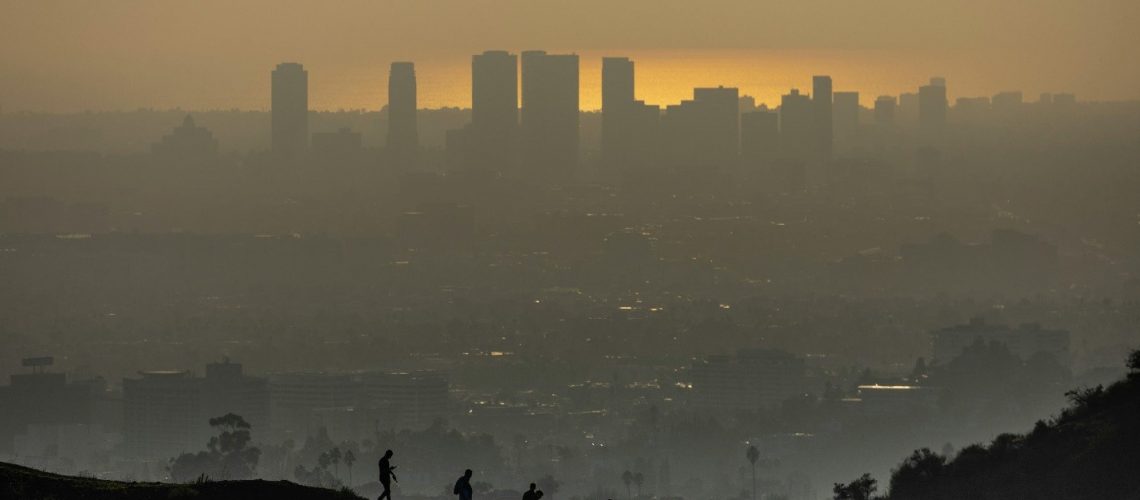
Guest Post by Tucker Melles, 2024-2025 Sustainability Leadership Fellow and Ph.D. Candidate in the Department of Chemistry at Colorado State University
Earth’s atmosphere is one of our greatest shared resources and provides many ingredients required for life. We breathe oxygen from the atmosphere, weather systems distribute water, and the ozone in the upper atmosphere protects us from harmful radiation. However, we have negatively impacted our atmosphere in several different ways. One of the most well-known ways we have impacted our atmosphere is through the emission of greenhouse gases, which have adversely affected our climate. A lesser-known manner in which we have impacted our atmosphere is the emission of aerosol and aerosol precursors that impact human health.
When most people hear the term aerosol, they generally think of a spray container. However, aerosols are any sort of particulate matter, a mixture of microscopic solid and liquid particles, suspended in a gas. The diameter of these particles is only a fraction of the width of a human hair, yet they can be hazardous to human health. Due to their small size, inhaled particles can infiltrate our lungs and introduce harmful pollutants.[1] Exposure to particulate matter is associated with cardiovascular and respiratory health issues.[2] Globally, 1 million premature deaths are attributed to particulate matter exposure, making it a major health hazard.[3] Exposure to harmful particulate matter is typically higher in urban areas than in rural areas, and people of color are disproportionately impacted by particulate matter.[4]
There are multiple origins of these hazardous particles. Particles can be directly emitted into the atmosphere, as in the case of dust or soot, or they can form via condensation of vapor to particulate matter. The latter occurs when volatile chemicals (chemicals with high vapor pressure that exist primarily in the gas phase) react in the atmosphere to become less volatile, transfer to particles, and contribute to secondary organic aerosol. Secondary organic aerosol is important because it makes up a significant fraction of particulate matter.[5] Additionally, the reaction of these volatile chemicals contributes to ground-level ozone production, which, unlike ozone in the stratosphere, is hazardous to human health.
The volatile chemical precursors (e.g., isoprene, carbitol, benzyl alcohol) to secondary organic aerosol are emitted from trees, fossil fuels, and an assortment of industrial and personal care compounds collectively known as volatile chemical products (VCPs). There has been progress in improving air quality over the past several decades. Regulations and technological innovations, such as the catalytic converter, have led to a decline in tailpipe emissions, reducing emissions of secondary organic aerosol precursors.[6] This decline in transportation-related emissions has resulted in emissions from other sources, such as VCPs, contributing to a larger fraction of secondary organic aerosol production.
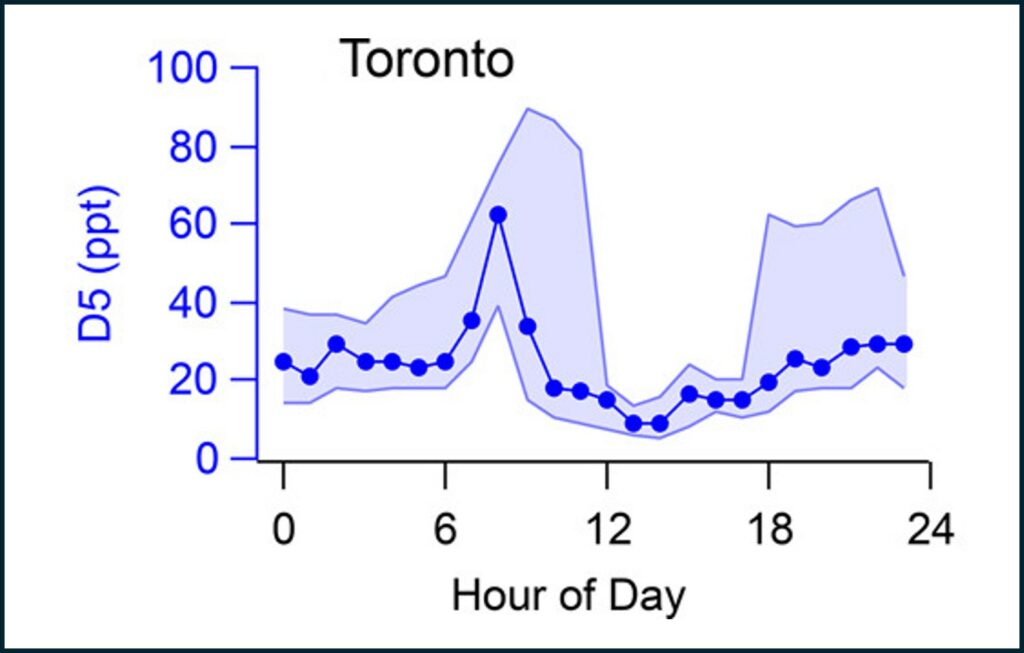
VCPs are part of our everyday lives, including products such as glues, paints, and solvents, but also personal care products like shampoos and perfumes. Look at the ingredient list of your deodorant, and there is a decent chance you’ll see D5-siloxane listed as an ingredient. D5-siloxane is a volatile compound most often found in personal care products and is used as a tracer for tracking emissions from VCPs. In urban areas, D5-siloxane levels spike as commuters leave their homes for the day (Image 2).[7] However, D5-siloxane is just one example of the hundreds of volatile compounds that make up the broad class of VCPs.
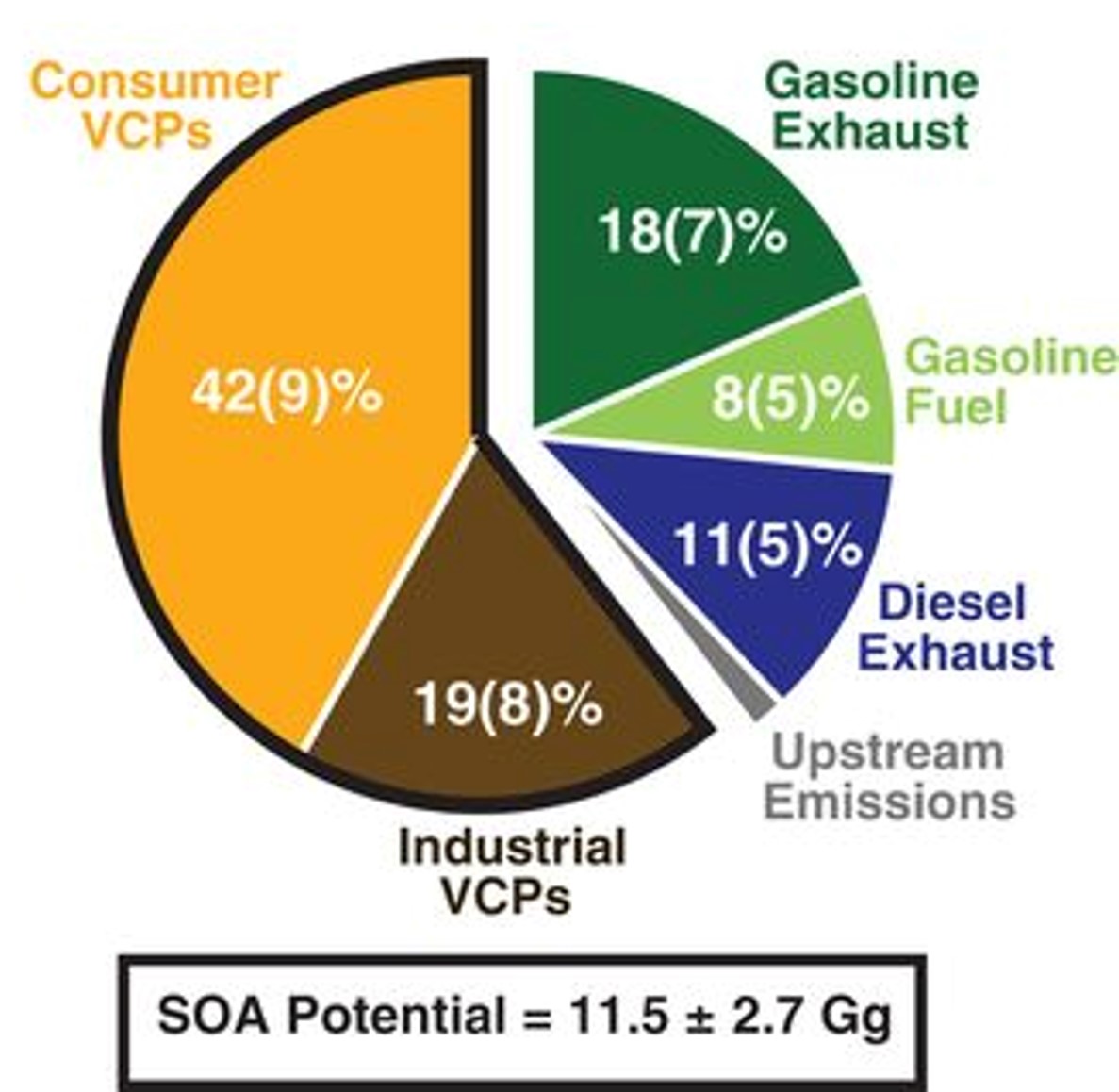
To understand the contribution of VCPs to the production of harmful secondary organic aerosol, we must understand which of the many components produces the most aerosol. Modeling work suggests that emissions from VCPs contribute more to secondary organic aerosol mass than fossil fuel sources in major urban areas (Image 3).[8] While VCPs are likely a major contributor to SOA, uncertainty exists. The difficulties in estimating VCP contributions to secondary organic aerosol are due to the vast number of chemicals of different sizes, structures, and compositions that make up VCPs.
In an ideal world, we would study the chemical reactions of the many compounds to identify their aerosol formation potential. Unfortunately, this is not practical, so what we study instead is how different structural characteristics impact a molecule’s chemistry and aerosol formation to try to understand a class of compounds. For example, the presence of oxygen atoms in a molecule opens up additional reaction pathways not found in molecules lacking oxygen atoms. Our understanding of the contribution of tailpipe emissions to SOA and ozone production led to the development of technology and regulations that improved air quality. Hopefully, similar progress can be made for VCPs emissions and subsequent SOA production.
VCPs have emerged as a significant contributor to particulate matter that warrants further study. As fossil fuel emissions continue to decline, the fraction of SOA from VCP sources will likely increase. Laboratory experiments, field observations, and modeling studies can all be applied to improve our understanding of the drivers of poor air quality. Studying the chemistry of SOA production from VCP sources allows us to improve our understanding of sources negatively impacting air quality and to ideally keep improving air quality in our communities.
Sources
[1] Thangavel, P., Park, D. & Lee, Y.-C. Recent Insights into Particulate Matter (PM2.5)-Mediated Toxicity in Humans: An Overview. International Journal of Environmental Research and Public Health vol. 19 7511 (2022).
[2] Anderson, J. O., Thundiyil, J. G. & Stolbach, A. Clearing the Air: A Review of the Effects of Particulate Matter Air Pollution on Human Health. Journal of Medical Toxicology vol. 8 166–175 (2011).
[3] Yu, W. et al. Estimates of global mortality burden associated with short-term exposure to fine particulate matter (PM2·5). The Lancet Planetary Health vol. 8 e146–e155 (2024).
[4] Tessum, C. W. et al. PM2.5 polluters disproportionately and systemically affect people of color in the United States. Science Advances vol. 7 (2021).
[5] Nault, B. A. et al. Secondary organic aerosols from anthropogenic volatile organic compounds contribute substantially to air pollution mortality. Atmospheric Chemistry and Physics vol. 21 11201–11224 (2021).
[6] McDonald, B. C., Gentner, D. R., Goldstein, A. H. & Harley, R. A. Long-Term Trends in Motor Vehicle Emissions in U.S. Urban Areas. Environmental Science & Technology vol. 47 10022–10031 (2013).
[7] Coggon, M. M. et al. Diurnal Variability and Emission Pattern of Decamethylcyclopentasiloxane (D5) from the Application of Personal Care Products in Two North American Cities. Environmental Science & Technology vol. 52 5610–5618 (2018).
[8] McDonald, B. C. et al. Volatile chemical products emerging as largest petrochemical source of urban organic emissions. Science vol. 359 760–764 (2018).