Guest post by Taylor Bacon, 2025-2026 Sustainability Leadership Fellow and Ph.D. Candidate in the Department of Soil & Crop Sciences
It feels like a particularly hard time to care about the planet, and as a reader of this blog, I’m sure you can relate. From news about near-daily climate disasters, ever-increasing atmospheric greenhouse gases, and the dire stakes of failing to act, the terms climate anxiety, ecological grief, and climate despair have become normalized in many of our lives.
In her 2025 book, marine biologist, policy expert, and climate writer Dr. Ayana Elizabeth Johnson suggests a shift in perspective, asking, “What if we get it right?” Instead of focusing on the bleak future in store if we fail, Johnson encourages us to move towards a vision of the future where we succeed. What does the world look like if we’re running on clean energy, breathing clean air, and growing (and ensuring access to) nutritious food, all while healing our working lands and safeguarding our natural resources?
My research focuses on the ecological impacts of solar energy and feels like a perfect case study for asking “What if we get it right?” What does it look like to generate zero-emissions electricity in a way that is aligned with the climate future we want to see?
Evolving Perspectives on Solar Energy
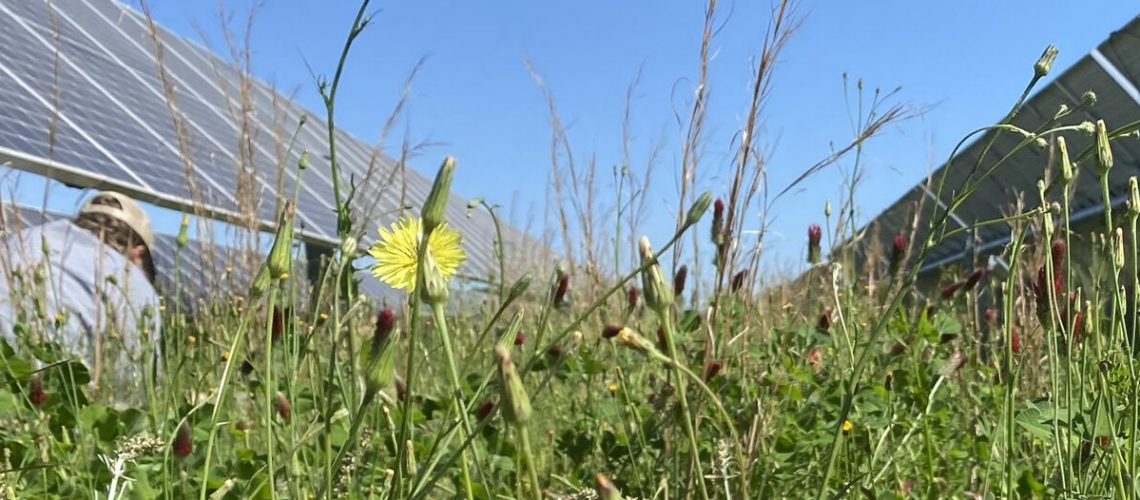
In the early days of solar energy development, it was common to bulldoze the land, remove topsoil, spray herbicide to suppress plant growth, or just lay down gravel – essentially, make the land under the array as lifeless as possible. Luckily, over the last few decades, we’ve started to shift away from these approaches. Now, some solar engineers, researchers, land managers, and farmers are asking: What if we integrate the solar array into the ecosystem rather than displacing it? This shift from viewing solar arrays as industrial power plants to a novel ecosystem has inspired entirely new fields of both research and practice.
Over the last decade, the fields of “ecovoltaics” (ecosystem services + solar energy) and “agrivoltaics” (agriculture + solar energy) have emerged under the umbrella of “multi-use solar”, exploring the integration of solar energy in novel ecosystems. Scientists are applying well-established research methods to these energy landscapes, studying ecophysiology, hydrology, micrometeorology, soil biogeochemistry, and much more – all based on the premise that the solar panels are part of the ecosystem rather than a separate entity. On my research team, which focuses on integrating grazing with solar energy, we talk about these systems as “solar savannas.” In a “natural” savanna, the trees are a part of the ecosystem – they create localized climate conditions through shading, provide habitat, and play a central role in cycling water and nutrients. What if we thought about solar panels in the same way, as an integral part of these landscapes?
Co-Benefits of Multi-Use Energy Landscapes
Across the U.S. and the world, researchers from diverse disciplines are bringing their expertise to these novel ecosystems and uncovering exciting evidence of the potential of multi-use solar when we get it right.
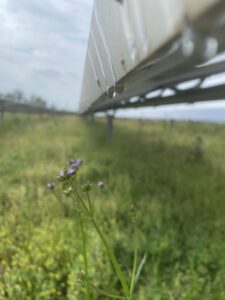
One of the biggest impacts of the solar “canopy” is its impact on climate conditions within the array. The solar panels create dynamic shading, which can lead to lower evaporation, cooler air temperatures, and elevated soil moisture. These results seem to be consistent across a range of ecosystems – from dry to more temperate systems. The question then becomes: what do these changes mean for the rest of the ecosystem?
In grassland systems, vegetative productivity can actually be increased with the presence of solar panels, especially during droughts. Ecosystem-forward solar array management, like planting and supporting pollinator habitat, can also benefit wildlife. In the Midwestern U.S., ecovoltaic solar arrays supported more grassland bird species and bat activity than neighboring agricultural land. In ecology, it’s well established that variation in a landscape supports greater biodiversity. We see evidence that the variability created by the solar panels can do just that. Preliminary results from my research have shown changes in plant community composition in response to the unique climate zones created by the solar panels. Below ground, researchers are even seeing patterning in soil microbial communities in response to these altered climate conditions.
In agricultural systems, researchers have found that the growing conditions created by the solar panels can increase crop yields and decrease water stress in high-value fruit and vegetable crops. In Southeastern Italy, grapevines grown within agrivoltaic systems yielded over 200% more grapes!! The panels can also reduce heat exposure for farm workers. These results are especially intriguing in the context of a warming climate, with extended droughts anticipated and, in many areas, already being experienced.
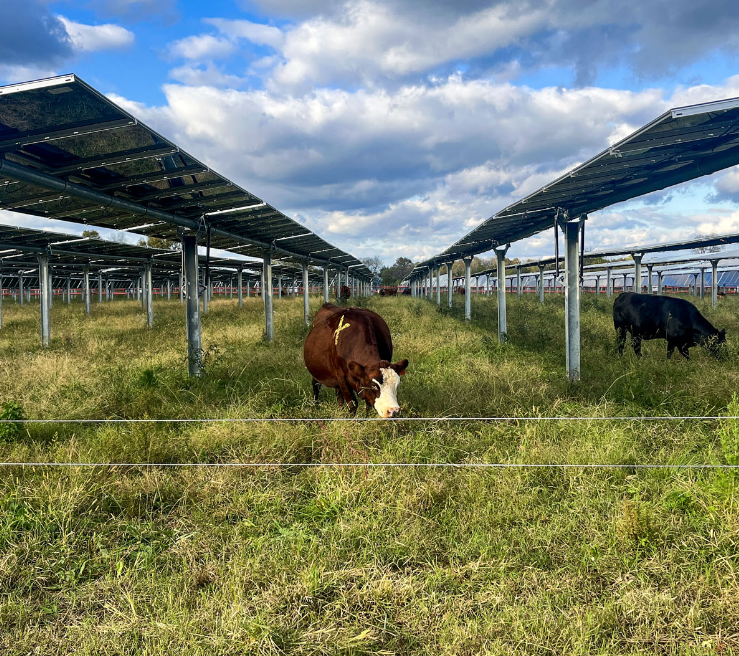
Beyond farming benefits, sheep grazing has long been used to manage vegetation in solar arrays, and recent research is emphasizing the synergies of solar grazing. From reduced heat stress to higher forage quality, integrating livestock and solar seems to be a win-win. My research team just launched a test-lab for cattle grazing with solar, and we’re excited to dig into both the animal welfare and ecosystem outcomes!
While we are just scratching the surface of understanding the strengths and limitations of multi-use solar energy, it provides an excellent case study for Dr. Johnson’s question, “What if we get it right?” Envisioning ecosystem-forward solar arrays has the potential to expand solar energy as both a climate mitigation and adaptation tool, supporting agricultural productivity, ecosystem restoration, and biodiversity in the face of a changing climate.