Guest Post by Kord Dicke, 2024-2025 Sustainability Leadership Fellow and Ph.D. Student in the Department of Biology and Graduate Degree Program in Ecology at Colorado State University
The human population recently surpassed 8 billion people and is projected to increase to 10 billion over the next
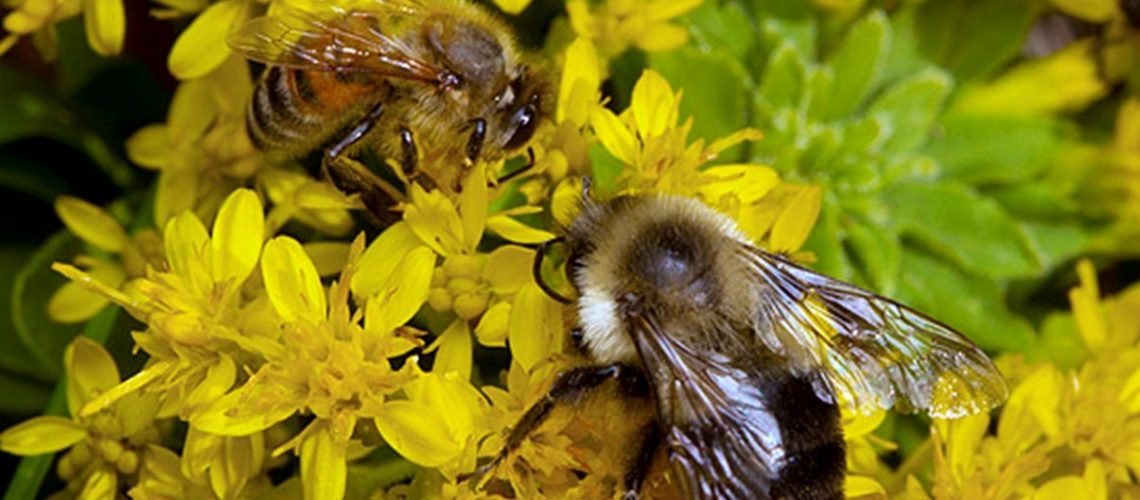
few decades.1 The rapid increase in human population places immense stress on global agricultural food production. Consequently, we must increase global food production while grappling with the effects of past intensive agricultural practices, increased drought, and biodiversity decline.2 One critical factor linked to future crop production is the preservation of pollinators. An estimated 35% of crops depend on pollinator services.3 Therefore, to sustainably increase food production, we must also focus on the preservation of pollinators. Bees are the most prevalent pollinators and are classified into either managed bees or wild bees.4 The most common managed bee is the honeybee (Apis mellifera).5 In contrast, native bees make up the local native population of bees in the surrounding environment (eg: bumble bees, sweat bees, mason bees, etc.). Preservation of both managed and native bees while also increasing our food production provides a complex problem that does not have a simple solution.
Honeybees as Agricultural Workhorses
While there are many managed bees used for pollination, the honeybee is by far the most prevalent due to their successful domestication and effectiveness as generalist pollinators.6 Their widespread use across the world has integrated them as a critical component in agricultural systems. However, the heavy reliance on honeybees is alarming as various factors such as disease and pesticides threaten honeybee populations in our agricultural systems.7 Further, it has been projected that honeybee populations will be insufficient for future agricultural demand.8 Common monocropping practices isolate farms from native habitats, which excludes native bees who rely on native floral resources.7 This places a heavy reliance on the success of honeybees in the face of stressed agricultural food production and creates an inadequate and fragile system that is vulnerable to collapse.
The Role of Native bees
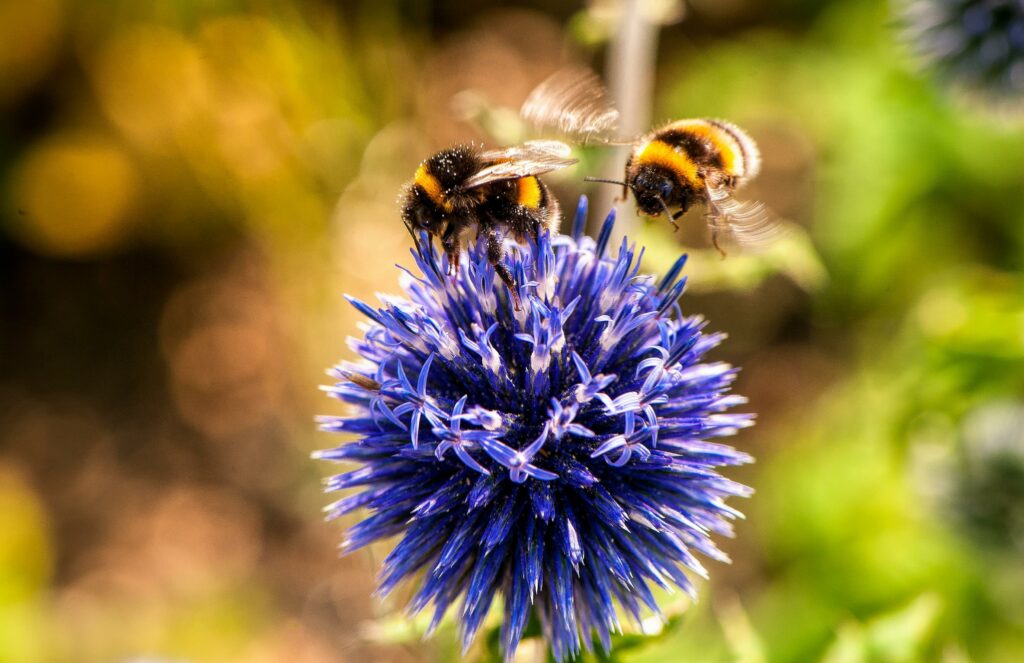
Native bees provide an alternative option that can supplement honeybee pollination services in agricultural systems but integrating native bees requires systematic changes. One of the most important factors influencing native bee populations is floral resource abundance and availability.9 Unfortunately, many large scale farm agricultural practices involve eliminating native floral habitat which is not conducive to native bees. Further, many farms use herbicides and pesticides that severely diminish native bee populations, while honeybees can often exhibit higher tolerance.6 A drastic change to our agricultural practices where farmers sacrifice large areas of potentially productive agricultural land for native habitat to promote native bee populations seems unlikely. Therefore, convincing a farmer to reduce pesticides/herbicides and restore native habitat poses a difficult challenge especially if these actions threaten their bottom line and they can use honeybees as a viable alternative option.
A Practical Path Forward
Overhauling the current agricultural system is impractical. Instead, smaller changes can support native bees and supplement honeybee pollination services without significantly impacting farmers or crop production. One attractive approach involves restoring small patchy native habitat on unused sections of farms, such as on plot borders. This practice would utilize areas that are not agriculturally productive and convert the area into beneficial native habitat. Native bees have demonstrated the ability to seek out patchy resources and persist in areas assuming all necessary resources are present in a small area.9 Additionally, previous research has shown that in farms with less agricultural intensification and more native habitat native bees can provide equivalent pollination services to that of honeybees.10 Therefore, only small changes in the current system can reap significant benefits. Further, restoration of native plant habitat will provide more than just a buffer against honeybee population decline, it can also provide economic benefits. Farmers must pay for honeybee pollination services, but supporting already present native bee populations can reduce honeybee rental costs by 15-50%, saving farmers in the United States up to $30 million per year.10
Our current agricultural system is on an unsustainable path that is highly susceptible to collapse due to our heavy reliance on honeybees. To ensure long-term agricultural success, we must think of innovative solutions to shift our current system to one that balances crop productivity with pollinator preservation. Implementing small patches of native habitat is one strategy that can strengthen the system without disrupting farmers’ livelihoods. While there are surely other factors that need to be addressed in agricultural systems to promote native bee abundance and diversity (eg: pesticides and herbicides), taking a small step in the right direction will lead us to a more sustainable future.
References
1. United Nations. Population. https://www.un.org/en/global-issues/population
2. Van Dijk, M., Morley, T., Rau, M. L., & Saghai, Y. (2021). A meta-analysis of projected global food demand and population at risk of hunger for the period 2010–2050. Nature Food, 2(7), 494-501.
3. Klein, A. M., Vaissière, B. E., Cane, J. H., Steffan-Dewenter, I., Cunningham, S. A., Kremen, C., & Tscharntke, T. (2007). Importance of pollinators in changing landscapes for world crops. Proceedings of the royal society B: biological sciences, 274(1608), 303-313.
4. Roubik, D. W. (Ed.). (1995). Pollination of cultivated plants in the tropics (Vol. 118). Food & Agriculture Org.
5. Southwick, E. E., & Southwick Jr, L. (1992). Estimating the economic value of honey bees (Hymenoptera: Apidae) as agricultural pollinators in the United States. Journal of economic entomology, 85(3), 621-633.
6. Kearns, C. A., Inouye, D. W., & Waser, N. M. (1998). Endangered mutualisms: the conservation of plant-pollinator interactions. Annual review of ecology and systematics, 29(1), 83-112.
7. Meixner, M. D. (2010). A historical review of managed honey bee populations in Europe and the United States and the factors that may affect them. Journal of invertebrate pathology, 103, S80-S95.
8. Aizen, M. A., & Harder, L. D. (2009). The global stock of domesticated honey bees is growing slower than agricultural demand for pollination. Current biology, 19(11), 915-918.
9. Roulston, T. A. H., & Goodell, K. (2011). The role of resources and risks in regulating wild bee populations. Annual review of entomology, 56(1), 293-312.
10. Kremen, C., Williams, N. M., & Thorp, R. W. (2002). Crop pollination from native bees at risk from agricultural intensification. Proceedings of the National Academy of Sciences, 99(26), 16812-16816.