Guest post by Anson Call, 2025-2026 Sustainability Leadership Fellow and Postdoctoral Fellow in the Department of Forest and Rangeland Stewardship and Colorado Forest Restoration Institute.
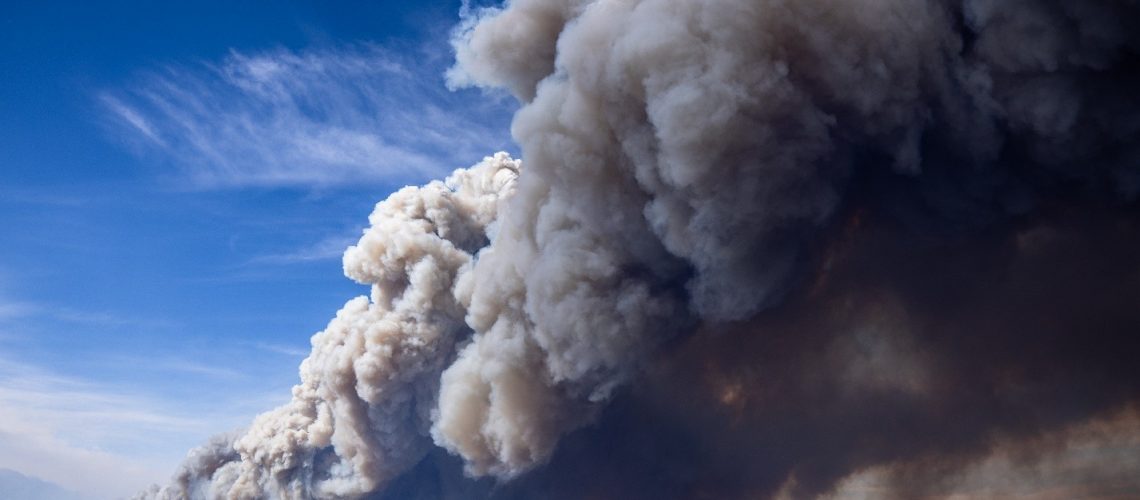
It’s barely noon, but the sun glows like a dim traffic light. The air tastes metallic, and ash falls from the sky like snow. If you live in the American West, you’ve likely experienced this firsthand, perhaps even recently. It’s true: wildfires are getting bigger. Though wildfires are often a natural part of a healthy forest, extreme wildfires are damaging ecosystems in ways that are effectively permanent3. To top it all off, climate change is expected to make the problem worse4.
How did we get here? For decades, we’ve been trying to prevent forest fires (Smokey Bear, anyone?). This strategy represents a sharp break from thousands of years of Native American stewardship, when frequent, low-severity ground fires were actively encouraged5. Without regular, low-severity fire, flammable vegetation has accumulated across western forests. Coupled with a warming, drying climate, we’ve accidentally created the perfect recipe for explosive, catastrophic wildfire. Now, when wildfires start, they can be impossible to stop.
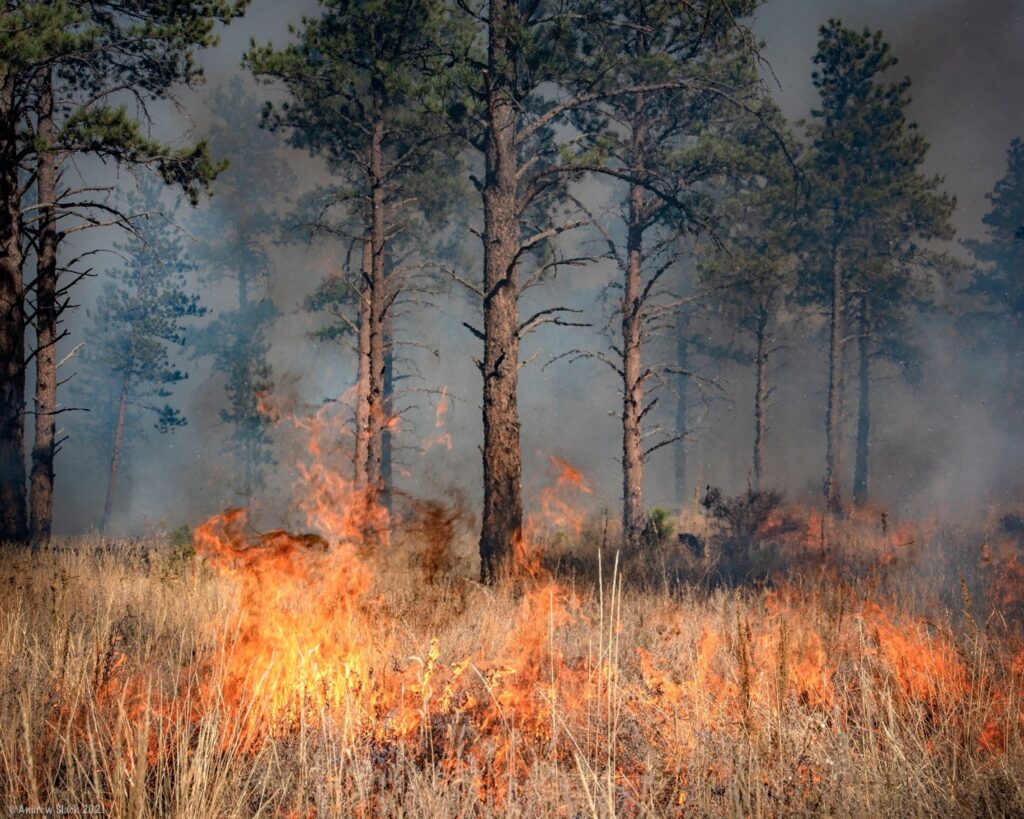
Counterintuitively, the solution to this crisis may be more wildfire, not less. If we can bring back the frequent, low-severity fires of pre-colonial times, flammable vegetation wouldn’t get the chance to accumulate. Catastrophic fires would once again become the outliers—not the all-too-regular occurrence they are today. But we’re faced with a Catch-22: to have low-severity fire, we need low fuel loads. To get low fuel loads, we need low-severity fire. How do we reintroduce low-severity fire when vegetation has already accumulated to extreme levels?
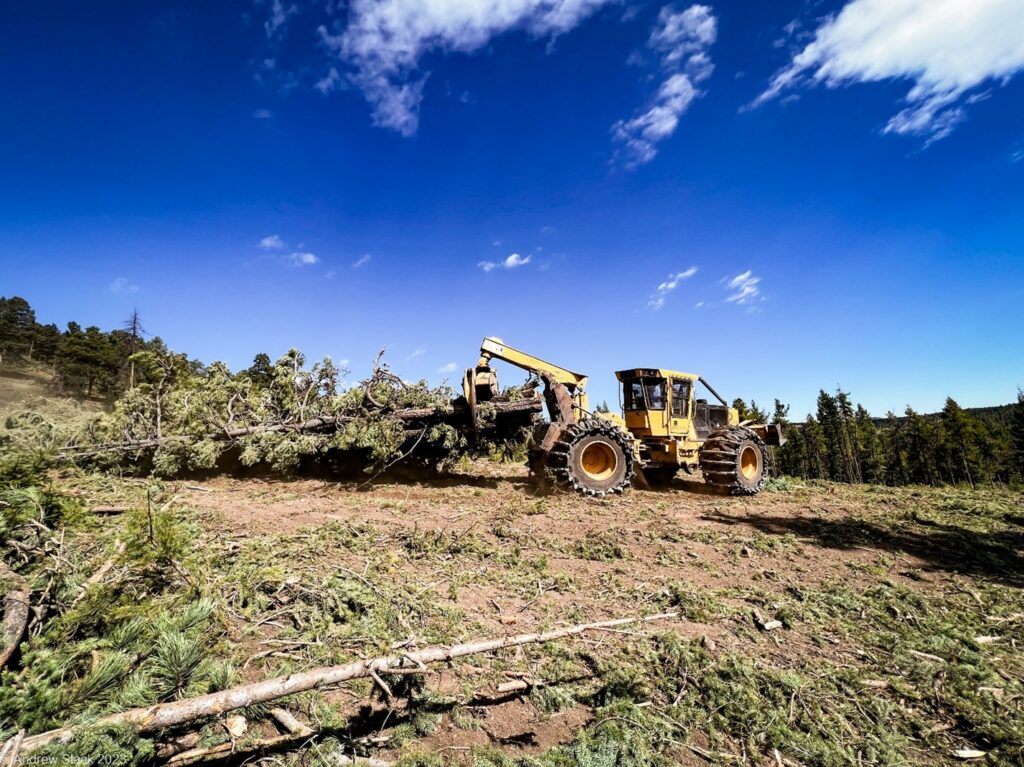
Increasingly, the solution to this paradox is a set of practices known as fuel treatments. The common goal of all fuel treatments is to remove or rearrange woody vegetation to make the forest less flammable. This usually involves logging small trees and clearing brush, though sometimes larger trees are also logged. Large-tree logging can also produce valuable timber, which helps offset the cost of fuel treatments and allows land managers to tackle larger, more ambitious projects. By reducing fuel loads, the hope is that fuel treatments will provide a pathway for the return of low-severity fire.
As you might imagine, these treatments are controversial. With a history of ill-advised logging in the Western US, many environmentalists—including some scientists—are primed to resist any management that even resembles it6. The consequence? Fuel treatment plans are frequently challenged in courts. Sometimes, the plaintiffs prevail. When they do, it’s often because judges are unconvinced that fuel treatments will work as intended7,8. Perhaps we shouldn’t be surprised. Though the relationship between fuel and fire is straightforward, the complexity of the forest is anything but. And catastrophic wildfires are chaotic and unpredictable, almost by definition.
So, what do we really know about fuel treatments, and is it enough to justify their continued use? As it turns out, fuel treatments are well-studied by almost any measure. A 2016 review of the scientific literature found the “highest quality of evidence” that fuel treatments reduced the severity of subsequent wildfires9. More recently, a 2024 review examined 40 different peer-reviewed studies, finding a widespread, significant association between fuel treatments and reduced wildfire severity10. With this mountain of evidence, it’s hard to imagine how a skeptical judge could remain unconvinced.
However, judges are acutely aware of one critical point that scientists should know but often forget. That critical point is the distinction between association and causation, and it’s one of the most important distinctions they’re asked to make. Was it Colonel Mustard, in the library, with the candlestick, or was the Colonel simply in the wrong place at the wrong time? In other words, did Colonel Mustard cause the murder, or was he simply associated with the place of the murder and the murder weapon? For a judge, this distinction is everything, because it’s often the difference between guilt and innocence.
Scientists make this distinction too, but when it comes to fuel treatments, it’s an extraordinarily difficult task. Fuel treatments work by reducing fuel, but fuel is just one of many factors that affect wildfires. The other primary factors are weather (fires are more extreme in hot, dry, windy weather) and topography (fires travel faster and burn hotter when they’re moving up steep hills). Layered on top of these are the effects of wildland firefighters. Whether they’re dropping fire retardants, clearing strips of vegetation to create firebreaks, or even igniting their own fires (a technique known as “backburning”), firefighters clearly impact a fire’s outcome. All these factors interact in ways that can be difficult to disentangle. For example, flat areas usually burn at lower severity but also make fuel treatments easier to accomplish. As a result, fuel treatments are concentrated in flat areas. When we witness a treated area burning at low severity, we must ask, was the favorable outcome caused by the fuel treatment or by favorable topography?
The classic method of determining causation in science—the “gold standard”—is known as a randomized, controlled trial, or “RCT.” 11 In an RCT, fuel treatments are randomly applied across the landscape. Though other factors will still come into play, those factors won’t be correlated with the occurrence of fuel treatments. As a result, we know with certainty that any systemic differences between treated and untreated areas are caused by the fuel treatments alone. Ideally, a large and varied collection of RCTs would satisfy all doubts on the efficacy of fuel treatments, but this would be extraordinarily difficult to accomplish and might not pay off for decades. What if randomization requires that we implement a fuel treatment in extremely rugged terrain? What if our randomly treated areas don’t experience a natural wildfire for many, many years? In fact, fuel treatment RCTs are so difficult that only one—one—RCT has ever been successfully completed12. All other peer-reviewed research is based on non-randomized, post-hoc, observational studies. That mountain of evidence? Through a judge’s eyes, it’s hardly a mole hill.
Because RCTs are so difficult, scientists have tried to make do without them. For this, they’ve been digging deep into the statistical toolbox. The precise techniques vary, but the general approach is to “control for” or “account for” the competing factors that distort the perceived effect of fuel treatments. However, identifying the right set of factors to control is no simple task. Get it right, and you’ve got your answer, exactly as if you had done an RCT. Get it wrong, and you might accidentally make the distortion worse.
Unfortunately, as scientists studying fuel treatments, we have struggled to get this right. Without clear guidance on which factors to control for, the current research landscape is a statistical wild west. In the 40 studies cataloged in the 2024 review10, almost every one of them uses a unique statistical model, and the estimated effects sizes vary widely. Of course, some variety is permissible; slight variations in statistical models can still lead to the same correct answer. The problem is that the answers are often substantially different, and no one can say with confidence which—if any—of the current models are correct. When a judge sees 40 different models and effect sizes that swing from “huge” to “barely noticeable,” they are right to be skeptical. It gives the impression that scientists don’t know what we’re doing, and in a sense, they’re not wrong. We’ve put too much stock into associations, when the only currency that matters are causes.
To move the science forward, two opportunities for improvement emerge: 1) we need a criterion for identifying the right statistical model, and 2) we need a justification for this criterion that’s strong enough to satisfy the naysayers. With these two things in hand, scientists can escape the wild west of statistics and move toward confident understanding. In this scientist’s view, the second need has already been filled, and it’s known as Structural Causal Modeling (SCM). Developed by Judea Pearl and others in the early 2000s,13 SCM follows from fundamental rules of logic, and provides a robust framework for distilling complex research questions into tractable, mathematical forms. With SCM, the crux of any problem is identifying the most reasonable cause-and-effect relationships between the relevant factors in your system. From there, the strengths of cause-and-effect relationships are easily calculated.
The first need—application of SCM to find the right statistical model—may not be far off. For starters, many cause-and-effect relationships are patently obvious. For example, topography causes fuel treatments, not the other way around. In other words, topography may restrict where fuel treatments are located, but fuel treatments will never cause meaningful changes in topography. Granted, there are a few cause-and-effect relationships that will be difficult to sort out, but there are no insurmountable hurdles. We won’t ever have perfect knowledge of all causes and effects, but where necessary, imperfect knowledge and assumptions can stand in. The real benefit of SCM is that it forces assumptions to be stated explicitly, where they can be questioned and debated. These structured debates, constrained to the plausibility of specific key assumptions, represent exactly the type of debate that lawyers, judges, and the public at large can understand. If scientists in the wildfire research community can understand and embrace SCM, we’ll communicate more clearly, increase transparency, and build trust with the broader community.
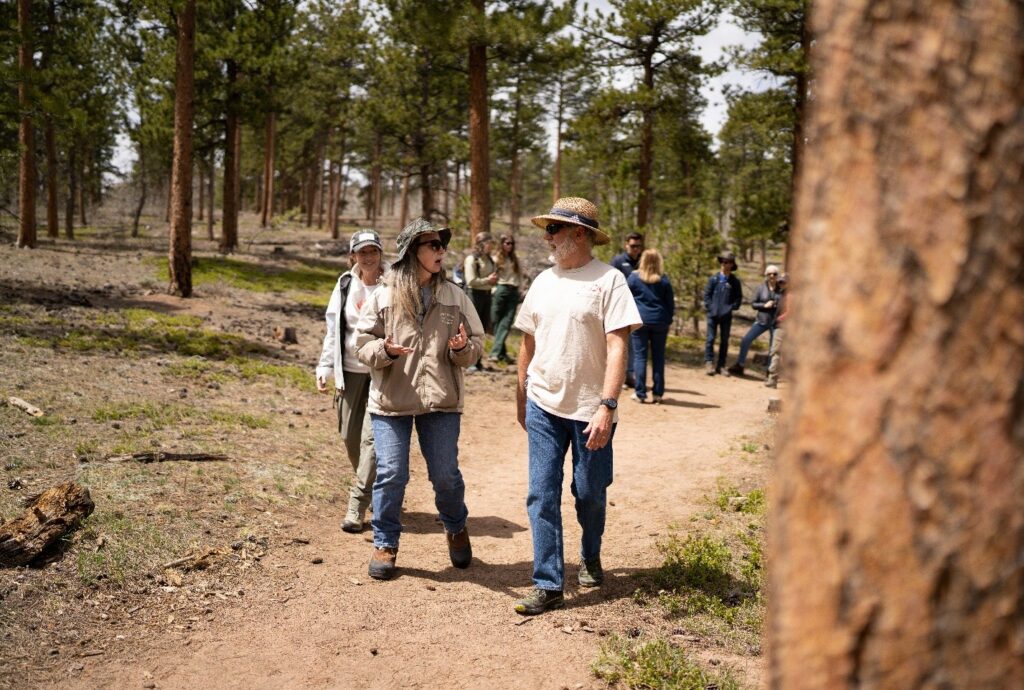
Calls for the increased application of SCM in ecology are on the rise14–16. Though SCM is beginning to penetrate wildfire research17,18, it hasn’t yet been applied to ask whether fuel treatments are effective. As part of the ReSHAPE Progam (www.reshapewildfire.org), I’m proud to say that we’ve created the largest-ever database of fuel treatments19, and we’re currently working to release the first-ever SCM of fuel treatments and wildfire burn severity. We don’t expect our model to be perfect. However, we’re hopeful that our forthcoming work will be the first step out of the statistical wild west, towards a future for the American West that’s safe from catastrophic wildfire.
- Parks, S. & Abatzoglou, J. Warmer and Drier Fire Seasons Contribute to Increases in Area Burned at High Severity in Western US Forests From 1985 to 2017. Geophys. Res. Lett. 47, (2020).
- Modaresi Rad, A. et al. Human and infrastructure exposure to large wildfires in the United States. Nat. Sustain. 6, 1343–1351 (2023).
- Coop, J. D. et al. Wildfire-Driven Forest Conversion in Western North American Landscapes. BioScience 70, 659–673 (2020).
- Littell, J. S., McKenzie, D., Wan, H. Y. & Cushman, S. A. Climate Change and Future Wildfire in the Western United States: An Ecological Approach to Nonstationarity. Earths Future 6, 1097–1111 (2018).
- Eisenberg, C., Prichard, S., Nelson, M. P. & Hessburg, P. Braiding Indigenous and Western Knowledge for Climate-Adapted Forests: An Ecocultural State of Science Report. https://adaptiveforeststewardship.org/ (2024).
- Dominick A., D., Lee, D., Bond, M. & Hanson, C. Logging to ‘Save’ Northern Spotted Owls From Wildfires Will Not End Well • The Revelator. The Revelator https://therevelator.org/logging-northern-spotted-owls/ (2025).
- Higginson, S. A. Bark et al. v. United States Forest Service. (2020).
- Clarke, M. D. Klamath-Siskiyou Wildlands Center v. United States Bureau of Land Management. (2024).
- Kalies, E. L. & Yocom Kent, L. L. Tamm Review: Are fuel treatments effective at achieving ecological and social objectives? A systematic review. For. Ecol. Manag. 375, 84–95 (2016).
- Davis, K. T. et al. Tamm review: A meta-analysis of thinning, prescribed fire, and wildfire effects on subsequent wildfire severity in conifer dominated forests of the Western US. For. Ecol. Manag. 561, 121885 (2024).
- Jones, D. S. & Podolsky, S. H. The history and fate of the gold standard. The Lancet 385, 1502–1503 (2015).
- Brodie, E. G., Knapp, E. E., Brooks, W. R., Drury, S. A. & Ritchie, M. W. Forest thinning and prescribed burning treatments reduce wildfire severity and buffer the impacts of severe fire weather. Fire Ecol. 20, 17 (2024).
- Pearl, J. Causality: Models, Reasoning, and Inference. (Cambridge University Press, Cambridge ; Tokyo, 2009).
- Byrnes, J. E. K. & Dee, L. E. Causal Inference With Observational Data and Unobserved Confounding Variables. Ecol. Lett. 28, e70023 (2025).
- Arif, S. & MacNeil, M. A. Applying the structural causal model framework for observational causal inference in ecology. Ecol. Monogr. 93, e1554 (2023).
- Siegel, K. & Dee, L. E. Foundations and Future Directions for Causal Inference in Ecological Research. Ecol. Lett. 28, e70053 (2025).
- Mustofa Irawan, A. et al. Multiparameter Causal Models for the Estimation and Explainability of Wildfire Burned Area. IEEE J. Sel. Top. Appl. Earth Obs. Remote Sens. 18, 14501–14516 (2025).
- Young, J. D. et al. Containment lines, PODs and suppression success: a case study of the 2021 Schneider Springs Fire. Int. J. Wildland Fire 34, WF25124 (2025).
- Call, A. et al. A new geodatabase of fuel treatments across federal lands in the USA. Sci. Data 12, 1485 (2025).