
Guest Post by Azmal Hossan, 2024-2025 Sustainability Leadership Fellow, and Ph.D. Student in the Department of Sociology and InTERFEWS at Colorado State University
- Workshop on Decolonization
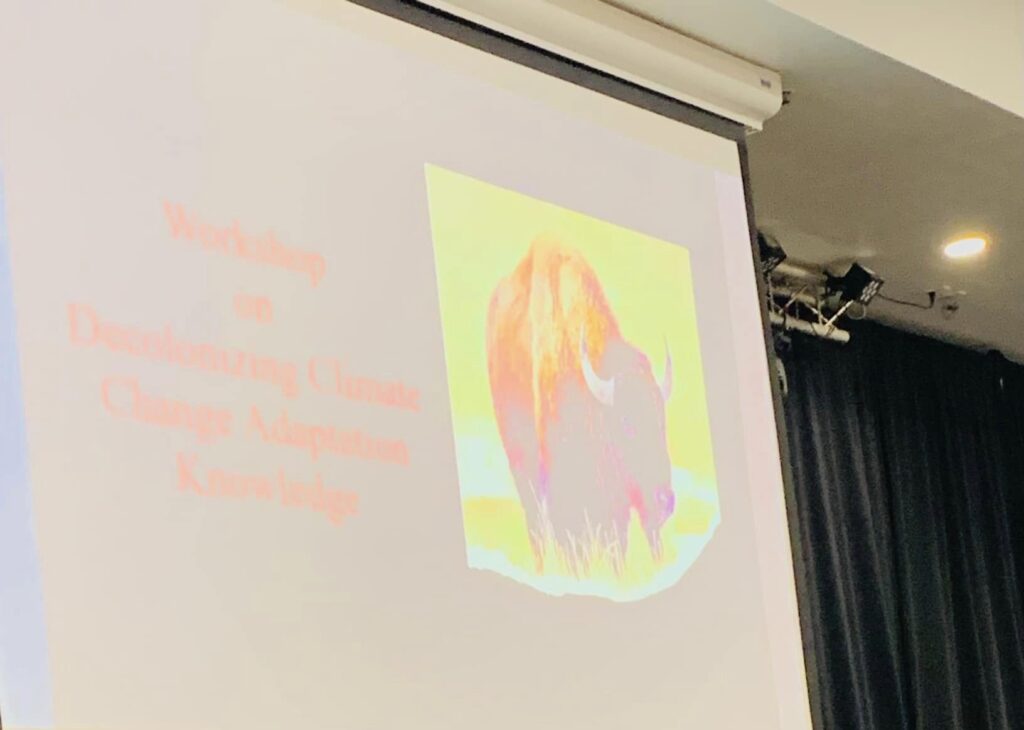
We, the Lakota People, know our traumatic history. You don’t need to remind us of that. It is unsettling and may create obstacles for future collaboration. I was not ready for the comment made by one of the panel members of the Decolonizing Climate Change Adaptation Knowledge workshop I organized recently. It was September 19, 2024, a sunny beautiful Thursday morning with a soothing breeze outside. I just finished my 45-minute-long presentation on my Ph.D. dissertation research proposal in front of a houseful audience and a panel of experts gathered at the conference center of the Royal River Casino and Hotel located in the Flandreau Santee Sioux Tribal Reservation, one of the nine federally recognized Tribal reservations in South Dakota. The audience and panel members are the registered participants of the two-day-long Annual Water and Climate Conference 2024 organized by the Great Plains Tribal Water Alliance (GPTWA), a South Dakota-based Tribal grassroots organization and a consortium partner of North Central Climate Adaptation Science Center housed at the University of Colorado Boulder. GPTWA works for Tribal climate resilience through Tribal water sovereignty along the Missouri River Basin through the revitalization of treaty-mandated Tribal self-determination capacity in water resource management. I organized a participatory workshop with Tribal knowledge holders on the second day of the conference as part of my participatory action research Ph.D. dissertation project titled “Quest for ‘Collective Continuance’ in the Settler Colonial Land: Tribal Climate Change Adaptation through Self-determination in the Northern Great Plains.” The annual conference is one of the largest gatherings of Tribal researchers, practitioners, resource managers, leaders, and elders generally known as Tribal knowledge holders in the Northern Great Plains region. I took this opportunity to reach out to those Tribal knowledge holders with my research project to fulfill the participatory action research requirement for my United States Geological Survey-supported dissertation research project, and the GPTWA is my co-partner in this project. I developed this research partnership with the Tribal organization through a Student Internship position I have been pursuing for the last one and a half years.
One of the major goals of the workshop is to ensure the inclusion of the Tribal voices in the research process often overlooked in the Western science-dominated climate change adaptation research and knowledge production. There were three parts of the workshop: a PowerPoint presentation of the project by myself followed by a Q&A session, a panel discussion by a panel of four members with expertise on settler colonialism, Tribal climate change adaptation, traditional ecological knowledge, and decolonizing methodologies, and an open discussion session with all the participants. The panel members were selected purposively to ensure the representation of academic researchers, Tribal leaders, Tribal elders, and Tribal youths, respectively so that I could receive a wide variety of critical feedback. One of the panel members was a woman ensuring representation of Tribal women. I started my PowerPoint presentation by showing an image of the mass burial of the victims of the Wounded Knee Massacre that took place in Wounded Knee Creek of South Dakota against the Lakota people by the United States Army in 1890 as a response to the Tribal nation’s attempt to revive one of their traditional spiritual practices known as Ghost Dance. Ghost Dance is a Native American spiritual movement started around 1870 among the Northern Paiute in Nevada and adopted by the Lakota in early 1890 to address violence by White settlers against them, resist forced assimilation, restore Tribal lands, food supply, and traditional lifeways disrupted by settler colonialism and severe drought. Around three hundred Lakota Indians were brutally killed during the massacre and half of them were women and children. I used the image to show the history and legacy of violence committed by the White settlers against the Tribal nations in the region which makes them less adaptable to climate change. But the comment I started this writing with is one of the critical feedback that reminds me why it is important to unlearn and relearn the Tribal history and context if I want to contribute to the decolonization of climate change adaptation research and knowledge production through Tribal engagement.
- My Social Positionality
I am a Ph.D. student of Sociology with research interests in decolonization of climate change adaptation and environmental justice at Colorado State University (CSU) – one of the leading land grant research universities in the United States with a solid track record in community-engaged climate change mitigation and adaptation (150+ climate-related courses are offered across the CSU campus), and sustainability research, practices, and knowledge production. CSU has earned a top-four ranking in the 2024 Sustainable Campus Index calculated by the Association for the Advancement of Sustainability in Higher Education (AASHE). The university has been in that position for all 10 years among the doctoral institutions for all AASHE’s rankings. It acknowledges that the land CSU is on today is the traditional and ancestral homelands of Tribal nations like Arapaho, Cheyenne, and Ute. It recognizes the Tribal peoples as original stewards of this land and all the relatives within it. Through this acknowledgment, CSU acknowledges the strong connection Tribal nations still have to this land. The majority of my graduate coursework here at CSU aligned with my research interests. Originally, I am from Bangladesh, a poster child of climate change with a history and legacy of European colonialism – one of the contributors to climate change vulnerability acknowledged by the most authentic scientific reports on climate change. Before coming to the United States for graduate study, I conducted one of my Two MA theses on how climate change has become a significant threat to Tribal communities in Bangladesh in maintaining their traditional livelihoods and how they are adapting to changing climate by using their traditional and customary practices. This social position, graduate college training, and previous research experience made me a sort of confident that I am well-trained on how to engage with Tribal nations in the United States – a country established through forceful and violent settlement by the European White Christians – in conducting participatory action research on their climate change adaptation. However, the comment I received from one of the panel members of the workshop reminds me that there’s a long way to go with my journey toward decolonization of climate change adaptation research and knowledge production. This is because (settler) colonialism is not an event, rather it is a continuous process and structure generating multilayered and multigenerational trauma among the Tribal Peoples. Consequently, decolonizing research in a settler colonial context should also be a continuous process. Unlearning and relearning this multilayered and multigenerational trauma of Tribal nations exacerbated by climate coloniality – colonialism uses climate change as a tool to haunt the past, present, and future – are the two most essential tasks of this process.
- Scientific basis of the Connection between (Settler) Colonialism and Climate Injustice
For the first time in its history, the Intergovernmental Panel on Climate Change (IPCC), in its latest report, acknowledged that colonialism has been playing a crucial role in accelerating the climate change process and increasing the vulnerability of marginalized communities specifically Tribal communities around the world. IPCC is the highest scientific authority in producing knowledge on climate change science and policy, mitigation of, and adaptation to climate change. In its Sixth Assessment Report published last year, IPCC mentions, “Vulnerability is exacerbated by inequity and marginalization linked to e.g., gender, ethnicity, low incomes, informal settlements, disability, age, and historical and ongoing patterns of inequity such as colonialism, especially for many Indigenous Peoples and local communities.” This is also echoed by the Fifth National Climate Assessment Report of the United States Global Change Research Program published last year. The report argues that “By exercising their right to self-determination, Indigenous Peoples can respond to climate change in ways that meet the needs and aspirations of their communities (very high confidence). However, their ability to exercise this right is often undermined by institutions and policies shaped by the impacts of settler colonialism (very high confidence).”
- Climate Change Vulnerabilities of the Tribal Nations in the Northern Great Plains
Decolonial scholars agree that settler colonialism abruptly disrupted Tribal relationships with nature in the United States and other corners of Mother Earth. I argue that this disruption is not only material, but also epistemological – how we know what we know, ontological – the study of the nature of existence and being, and cosmological – the study of the origin and development of the universe. I also argue that climate change has become the newest iteration of this disruption as it is created by the consumerist lifestyle of the settlers and colonizers of the Western industrialized countries. Unfortunately, this earth-damaging lifestyle is built on the consumption of finite resources extracted in an infinite way from the lands where Tribal nations have been living for time immemorial. They have been leading their lives practicing their traditional lifeways based on a reciprocal relationship with nature. The US Northern Great Plains region is the home of many Federally recognized Tribes. The region is experiencing unprecedented climate change-induced extreme events including severe droughts, increased hail frequency and size, floods, and wildfires. Tribal Nations in the region are on the frontline of climate change impacts exacerbated by historical and ongoing settler colonialism. Given their close relationship with the natural world rooted in their deep spiritual and cultural connections and traditional lifeways, Tribal Nations are the hardest hit by and less adaptable to climate change. The right to self-determination can help Tribal Nations respond to climate change in ways that meet the needs and aspirations of their communities. This is reflected in an ongoing research project I have been conducting at GPTWA. As a Student Intern, I have been conducting in-depth interviews with Tribal water resource managers to assess Tribal climate change adaptation water needs and priorities in South Dakota. The initial findings indicate that the Tribal nations are confronting multidimensional challenges in climate change adaptation in the Missouri River Basin often exacerbated by settler colonial water resource management practices. The right to self-determination is the most effective climate change adaptation strategy identified. Given my research interests, I was overwhelmingly influenced by this finding and developed my dissertation proposal and research questions by partnering with GPTWA. One of the objectives of the project is to dismantle the colonization of climate change adaptation research and knowledge production in the Missouri River Basin in specific and worldwide in general.
- Research as a Colonial Tool and the Urgency of Decolonization
With the objective in mind, I employed a participatory action research methodology using a decolonizing approach in the project where both researcher and research participants have equal opportunity to participate in developing research goals and methods, gathering and analyzing data, and disseminating the findings. Decolonizing methodologies refer to respectful and reciprocal approaches to research that strive to deconstruct colonizing practices and promote Tribal self-determination. However, as a previously colonized and currently non-Tribal researcher of color in the United States, I was not very aware that the term ‘research’ is one of the dirtiest words in the Tribal world’s vocabulary as it is inextricably linked to European colonialism. Colonizers have been using research as a tool to establish their supremacy over the colonized and to legalize their colonization under the Doctrine of Discovery – a philosophical foundation under which European White Christians believed that it was their God-mandated responsibility to establish their civilization, race, and religion in every corner of the world even by dehumanizing the Native people. This is because they believed that their civilization, their race, and their religion were the purest ones mandated by God. Measuring the mental capacity of Māori faculties by filling the skulls of their ancestors with millet seeds is one of the examples of this dehumanization process. This Western discourse about the Other has been supported by colonial institutions, vocabulary, scholarship, imagery, doctrines, bureaucracies, and styles. As a researcher, I intend to help the Tribal nations in the Northern Great Plains adapt to the changing climate through the revitalization of their self-determination capacity rooted in the practice of their traditional ecological knowledge. However, research has been a source of distress and oppression for Indigenous people because of inappropriate methods and practices. This is because researchers in the Western world often conduct research on Tribal peoples without decolonizing their research training. To avoid this harm to Tribal peoples during the research process, I need to decolonize my research training through an ongoing process of unlearning and relearning regarding who I am as a researcher and take responsibility for my research participant. And I understand that it is a lifelong learning process.
About the Author: Azmal Hossan is a Ph.D. student of Sociology and a Sustainability Leadership Fellow at the School of Global Environmental Sustainability at Colorado State University. His research is supported by Interdisciplinary Training, Education, and Research in Food-Energy-Water Systems at Colorado State University and the Diverse Knowledge Systems for Climate Adaptation Fellowship at the National Climate Adaptation Science Center, United States Geological Survey. He can be reached at [email protected].