
Guest Post by Sylvia Lee, 2024-2025 Sustainability Leadership Fellow and Ph.D. Candidate in the Department of Food Science and Human Nutrition at Colorado State University
What does it mean to eat sustainably? For some, sustainable eating means eating organic. Some believe it means eating locally. But like most things in life, it’s a lot more complicated than that. Eating organic foods and eating locally have their merits for the environment, but that’s not the entire story and there’s no “one-size-fits-all” sustainable diet. The Food and Agriculture Organization of the United Nations defines sustainable diets as,
“…those diets with low environmental impacts which contribute to food and nutrition security and to healthy life for present and future generations. Sustainable diets are protective and respectful of biodiversity and ecosystems, culturally acceptable, accessible, economically fair and affordable; nutritionally adequate, safe and healthy; while optimizing natural and human resources.1“
By this definition, my sustainable diet may not look exactly like your sustainable diet, and that’s okay. Researchers have tried to define a diet that is healthy for both people and the planet, for example, the EAT-Lancet Planetary Health Diet which emphasizes the consumption of non-starchy vegetables, whole grains, plant-sourced proteins, and unsaturated fat while advising against added sugar and red meat2. This approach balances the need for improved diet quality in the US, since diet is a major risk factor for chronic diseases like heart disease and diabetes.
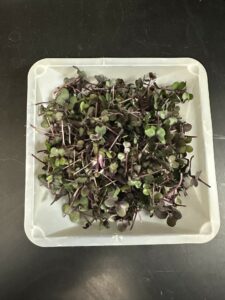
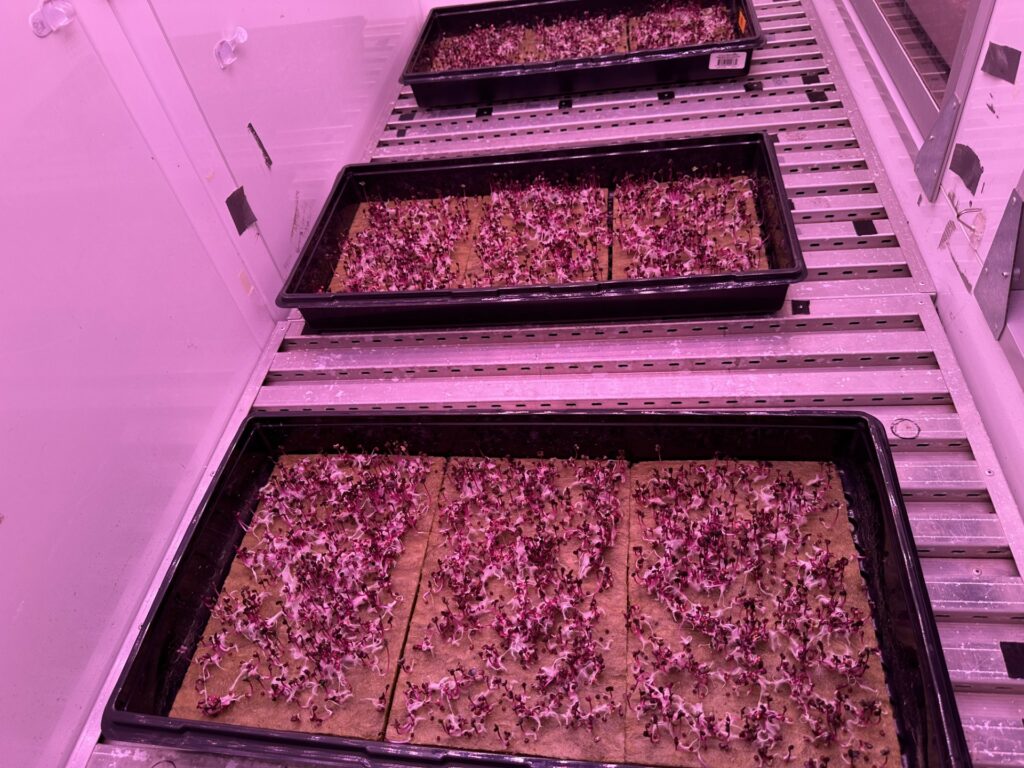
However, the Planetary Health Diet does not consider how and where food is produced, which is important for understanding how sustainable your food is. For example, consuming foods produced locally can reduce the amount of fossil fuel that was needed for transportation, however, this may not be feasible in all areas, and the definition of “local” needs to be flexible. Also, some growing methods are more water intensive than others. For example, my research focuses on controlled environment agriculture (CEA), which is also known as indoor farming, where we study how we can sustainably produce more nutritious foods with sustainability in mind. CEA uses up to 99% less water than conventional farming and allows for production in population centers and year-round production, but it requires more electricity3 and a lot of inputs that are not typically required for conventional agriculture, like LED lights, and an HVAC system. Improvements in indoor farm management have allowed growers to reduce electricity costs, like switching to LED lights and having the lights on during the night.
There’s no one-size-fits-all sustainable nutrition plan, but rather, the values that one holds (water conservation or protecting biodiversity or reduced emissions) will inform decision making. Additionally, it’s important to note that eating sustainably is a privilege, even in the United States. You may be thinking “That’s not very helpful. What do I need to DO?”. Well, there are some general guidelines that are agreed upon:
- Eat more plants.
- Eat more plant-based protein.
- Eat fewer processed foods.
For other suggestions, see this article by the Academy of Nutrition and Dietetics.
References:
- United Nations. Dietary Guidelines and Sustainability. https://www.fao.org/nutrition/education/dietary-guidelines/background/sustainable-dietary-guidelines/en/.
- Willett W, Rockström J, Loken B, et al. Food in the Anthropocene: the EAT–Lancet Commission on healthy diets from sustainable food systems. The Lancet. 2019/02/02;393(10170).
- Graamans L, Baeza E, Dobbelsteen Avd, Tsafaras I, Stanghellini C. Plant factories versus greenhouses: Comparison of resource use efficiency. Agricultural Systems. 2018/02/01;160.