
Guest post by Lucy Chalgren, 2026-2027 Sustainability Leadership Fellow and Ph.D. Candidate in the Department of Journalism & Media Communication
The first time I saw a green sea turtle, I was in high school, snorkeling with my family off the coast of Maui. I remember floating high above it, completely in awe. When we surfaced, my little sister declared that the turtle’s eyes were “as blue as diamonds.” This became a family favorite memory with a guaranteed giggle session, because sea turtles do not have blue eyes. (Top image: A Hawaiian Green Sea Turtle (Honu) inspiring awe at the water’s surface. Photo by Lucy Chalgren.)
That feeling of awe continues to follow me anytime I am outdoors, as wildlife has a way of stopping us in our tracks. A branch snaps, and a moose emerges from the willows along the Poudre River, and suddenly the world feels quiet. Across a Yellowstone valley, a momma Grizzly bear and her cubs tear into an elk carcass, stuffing their bellies before the harsh winter ahead. At dusk, a bat flickers overhead, out of sight before I can point. Wildlife inspires us, excites us, and can also stir a longing to be closer to them.
Our connection to animals is as old as humanity itself. We tell stories about them, name them, and see ourselves in them, like a sea turtle with diamond-blue eyes. This connection is beautiful and complicated. Seeing animals through a human lens can build compassion for wildlife but can shape expectations about how we should engage with them [1]. Sometimes, the very feelings that draw us to wildlife can draw us too close.
Why do we get so close?
Years later, I was living in Hawaiʻi for grad school, when an exciting email landed in my inbox. A research team was looking for students and research assistants to help with a project encouraging visitors to the islands to keep their distance from green sea turtles and spinner dolphins.
The project was called Amazing from Afar. In Hawaiʻi, federal guidelines recommend people stay at least 10 feet from green sea turtles [2]. Signs sharing this guidance had been up for years, yet many people still get too close [3]. This matters, because disturbing resting animals can put the animal and the visitor experience at risk [4].
The team started with a question I’d never thought to ask. Instead of asking how to state the guideline more clearly, they asked why people were getting close to these animals. A big part of the answer? Many visitors wanted a picture that captured their special encounter [3].
Instead of fighting this desire, the Amazing from Afar campaign invited visitors to take playful forced perspective photos, that only work from a distance. That’s when I had my aha moment. I had always thought of science communication, education, and outreach as a way to inspire awe to get people to care. Now I was seeing strategic communication. Instead of simply sharing information, strategic conservation communication is grounded in what people want and why they act the way they do, to help shape messages that encourage people to help with conservation efforts.
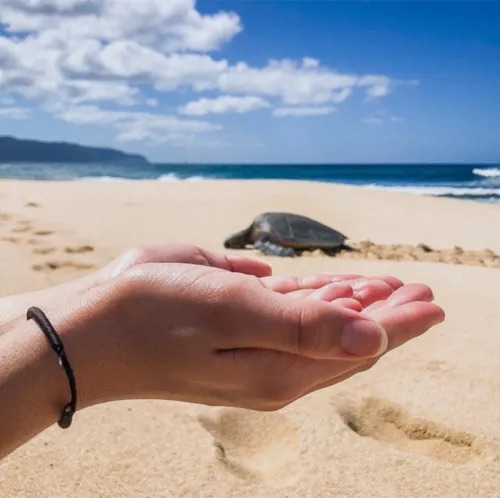
I was hooked. I spent days on this project sitting on beaches, watching the signs in action. With the campaign in place, the number of people who kept at least a 10-foot distance from the turtles nearly doubled [4]. Strategic communication was not simply inspiring awe, it was helping people to make a better choice for sea turtles.
The plot twist: We were out of our depth
Helping sea turtles was only half the story. The campaign also dove into human-spinner dolphin interactions. Hawaiian spinner dolphins will hunt offshore at night and rest in calm bays during the day, making them rather accessible to recreationists. In 2021 federal law required people to stay at least 50 yards from spinner dolphins [2]. One might expect that a law alone would be enough to keep people at a distance. Yet, before our campaign began, fewer than half the people we observed near resting dolphins maintained a 50-yard distance [4].
Same campaign, same strategy, but different results. It helped give sea turtles space, but around dolphins, behavior barely changed. People who got too close even tended to stay within the 50-yards for a longer time [4].
Why the difference? The experience is not quite the same. From 10 feet, witnessing a sea turtle is awe-inspiring. From 50 yards, a dolphin is mostly dorsal fin and an occasional leap from the water. The alternative forced perspective photo loses the element of fun and meaningfulness of keeping a respectful distance. Culture also likely plays a role in how people seek out experiences with dolphins. Dolphins have often been portrayed as friendly companions, and swimming with them as a magical experience [4]. A few weeks of signs cannot easily compete with that.
Bit by the research bug
While the dolphin results were not the success we hoped for, they still taught me a valuable lesson. Conservation challenges are not a one-size-fits-all, and sometimes the most useful findings are the ones that do not go as planned.
My time on the Amazing from Afar campaign left my head buzzing with questions. How do you change something as deep as a cultural norm? How can strategic conservation communication strengthen our collective efforts as a society? What does it look like to build a communication effort alongside communities?
It is safe to say, I had been bitten by the research bug. The only cure? Keep learning, asking questions, and doing my best to answer them. This insatiable desire to answer these questions led me to Colorado State University, where I realized conservation social science, was where I belonged.
Awe is just the beginning
I often think about my sister’s diamond-eyed sea turtle, swimming gracefully below us along the reef. Completely in awe, wanting the moment to never end. Our awe is what makes us want to be close. Strategic communication can help us honor that feeling while keeping a respectful distance from wildlife. As more of us continue to venture outdoors for a beautiful escape, finding ways for people and wildlife to share space sustainably will only matter more.
References
[1] Chalgren, L., Abrams, K. M., & Nankey, P. (2026). Anthropomorphizing wildlife in communications: A literature synthesis with implications for wildlife management and conservation. Journal of Applied Communications. https://doi.org/10.4148/jac.20845
[2] NOAA Fisheries Pacific Islands Regional Office. (2026, February 23). Viewing marine wildlife in Hawaiʻi. https://www.fisheries.noaa.gov/pacific-islands/marine-life-viewing-guidelines/viewing-marine-wildlife-hawaii
[3] Abrams, K.M., Molder, A.L., Nankey, P., & Leong, K. (2023). Encouraging respectful wildlife viewing among tourists: Roles for social marketing, regulatory information, symbolic barriers, and enforcement. Social Marketing Quarterly, 29(1), 67-86. https://doi.org/10.1080/17524032.2019.1649291
[4] Abrams, K. M., Chalgren, L., & Leong, K. M. (2026) Similar Tactics, Different Results: A Social Marketing Case Study of Marine Wildlife Viewing in Hawai i. Social Marketing Quarterly. https://doi.org/10.1177/15245004261490672